If you are searching for the Stand-Up India age limit 2026, the historical eligibility rule is clear: applicants under the original Stand-Up India Scheme had to be above 18 years of age. However, there is an important 2026 update that changes how this rule should be interpreted today: the original scheme was operational only up to 31 March 2025, and the Government has been working on a revamped version. The final eligibility and age rules for any replacement scheme should therefore be checked in its notified guidelines before applying.
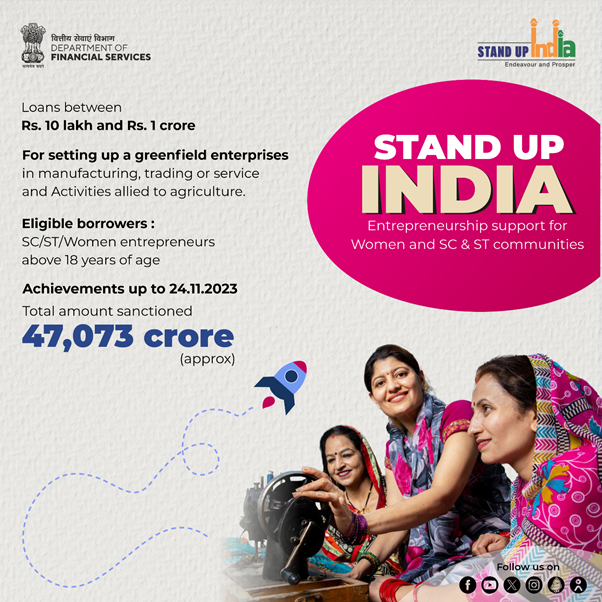
Table of Contents
Stand-Up India age limit 2026 at a glance
| Rule | Original Stand-Up India position | 2026 status |
|---|---|---|
| Minimum age | Above 18 years | Historical rule; original scheme ended 31 March 2025 |
| Maximum age | No separate maximum age was stated in the core eligibility rule | No final replacement rule published in the sources reviewed |
| Target applicants | SC/ST and/or women entrepreneurs | Original scheme only; revamped framework was under preparation |
| Business requirement | Greenfield enterprise | Original scheme requirement |
| Loan range | ₹10 lakh to ₹1 crore | Original scheme framework |
| Operational period | 5 April 2016 to 31 March 2025 | Original scheme ended |
What was the Stand-Up India age limit?
The original Stand-Up India eligibility rule required the borrower to be above 18 years of age. The Department of Financial Services described the scheme as providing composite loans of ₹10 lakh to ₹1 crore to entrepreneurs above 18 through Scheduled Commercial Banks. The scheme was designed for SC/ST and women entrepreneurs setting up greenfield enterprises in manufacturing, services, trading or activities allied to agriculture.
For age calculation, “above 18” should not be casually converted into a claim that the applicant could apply on the 18th birthday unless the applicable notification or bank process expressly permitted it. The safer reading of the original wording is that the applicant had to have crossed 18 years of age. A bank could also require documentary proof of date of birth during credit processing.
Is Stand-Up India available in 2026?
The original Stand-Up India Scheme is not an active scheme on the same 2016–2025 framework in 2026. The Department of Financial Services states that SUPI was valid up to 31 March 2025. Its 2026 material also refers to a new scheme for first-time entrepreneurs that was announced in the Union Budget and says the relevant process was being prepared.
In March 2026, News on AIR reported that the Finance Minister said the earlier Stand-Up India scheme had ended in March 2025 and that a revamped version was being redrafted after study by NITI Aayog and other departments. This means the old 18+ age rule should not be presented as a confirmed eligibility rule for a new 2026 scheme until the replacement framework is formally notified.
Why the 2026 status matters for age eligibility
Age-limit articles can become misleading when an older scheme rule is copied into a new year without checking whether the scheme itself is still operating. Stand-Up India is a good example. The original scheme had a clearly stated age threshold, but its approved operational period ended in March 2025.
- Historical rule: the original borrower had to be above 18.
- Original beneficiaries: SC/ST and/or women entrepreneurs.
- Original project test: the enterprise had to be a greenfield project.
- Original loan framework: ₹10 lakh to ₹1 crore.
- 2026 caution: the old rules should not be treated as final rules for a replacement scheme.
Who was eligible under the original Stand-Up India Scheme?
The original framework was aimed at SC/ST and women entrepreneurs. The core eligibility material described applicants as SC/ST and/or women entrepreneurs above 18 years. For non-individual enterprises, the scheme required at least 51% of the shareholding and controlling stake to be held by an SC/ST and/or woman entrepreneur.
The enterprise also had to be a greenfield project. In this context, greenfield meant a first-time venture of the beneficiary in manufacturing, services, trading or an activity allied to agriculture. The borrower was also required not to be in default to a bank or financial institution under the original eligibility framework.
Was there a maximum age under the original scheme?
The core Stand-Up India eligibility descriptions reviewed for this guide specify that the entrepreneur must be above 18 years. They do not state a separate general upper age ceiling in the same eligibility condition. Therefore, the original scheme is better described as having a minimum age threshold rather than a 18-to-X maximum-age band.
That does not mean a bank would ignore all other borrower considerations for an older applicant. Loan approval involves banking, credit, repayment and project-assessment requirements. The absence of a scheme-level maximum age in the cited eligibility rule should not be interpreted as a guarantee of loan sanction.
Stand-Up India loan amount and project rules
The original scheme facilitated a composite loan of ₹10 lakh to ₹1 crore. The loan could cover a term loan and working-capital component for an eligible greenfield enterprise. The project could fall in manufacturing, services, trading or activities allied to agriculture.
The original repayment period could extend up to seven years, including a moratorium period of up to 18 months. The scheme also provided for margin-money support of up to 15% through convergence with eligible government schemes, while the borrower was required to bring at least 10% of project cost as own contribution under the stated framework.
What happened after March 2025?
The Department of Financial Services records that the original SUPI scheme was valid up to 31 March 2025, in line with the 15th Finance Commission period. The department also referred to the Union Budget 2025–26 announcement of a new scheme for 5 lakh women, SC and ST first-time entrepreneurs, with term loans of up to ₹2 crore over the next five years and online capacity building for entrepreneurship and managerial skills.
The important point for an age-limit search is that an announcement of a replacement scheme is not the same thing as a finalized eligibility notification. Until the new scheme’s operational guidelines are formally issued, the old Stand-Up India age condition should be treated as historical rather than automatically applicable to a new 2026 application.
Stand-Up India age examples
| Applicant situation | Historical age-rule reading |
|---|---|
| Exactly 18 years old | Does not satisfy wording that says “above 18 years.” |
| 18 years and 1 day | Has crossed 18; historically fits the age wording, subject to all other rules. |
| 25 years old | Within the historical minimum-age requirement. |
| 50 years old | No separate maximum age is stated in the core historical eligibility wording. |
| 65 years old | Age alone was not given as a general upper cutoff in the core historical rule, but banking and credit requirements still applied. |
Documents and age proof
For the original bank-loan process, applicants had to satisfy the bank’s documentation and credit requirements. Date-of-birth evidence can be relevant whenever an age threshold applies. Depending on the lender and application route, applicants could also be asked for identity, address, category, business, project and financial documents.
- Proof of identity and date of birth.
- Address and contact details.
- SC/ST category documentation where applicable.
- Business or enterprise information.
- Project report and estimated project cost.
- Financial and banking documents required by the lender.
- Documents relating to ownership, shareholding or control for a non-individual enterprise, where applicable.
Stand-Up India vs other entrepreneurship schemes
Stand-Up India should not be confused with every other government entrepreneurship or credit programme. For example, PMEGP has its own age and eligibility framework, while Startup India uses an entity-age framework for recognition. The applicant’s age, business type, beneficiary category and financing need can therefore lead to different eligibility tests.
Common mistakes when checking Stand-Up India age eligibility
- Copying the old 18+ rule into 2026 without checking scheme status. The original scheme ended on 31 March 2025.
- Treating “above 18” as “18 or above.” Those phrases are not identical when a cutoff date is applied.
- Assuming an age-compliant applicant automatically qualifies for a loan. Category, greenfield-project, banking and credit requirements also mattered.
- Confusing Stand-Up India with Startup India. They are different initiatives with different eligibility concepts.
- Assuming the announced replacement scheme has the same rules. A new scheme can change age, beneficiary, project or loan conditions.
Frequently asked questions
What was the minimum age for Stand-Up India?
The original Stand-Up India Scheme required the entrepreneur to be above 18 years of age.
What is the Stand-Up India age limit in 2026?
The historical age rule was above 18, but the original scheme ended on 31 March 2025. A replacement or revamped framework was being prepared in 2026, so its final age limit should be taken from the notified rules rather than assumed from the old scheme.
Is there a maximum age for Stand-Up India?
The core historical eligibility wording reviewed here does not state a separate general maximum age. That is different from saying that every older applicant would automatically receive a loan.
Can an exactly 18-year-old apply under the old rule?
The original wording says “above 18 years,” so it should not be interpreted as an automatic eligibility confirmation on the 18th birthday itself.
Is Stand-Up India still active in 2026?
The original scheme was operational through 31 March 2025. In 2026, government material referred to a replacement/revamped framework being developed. Applicants should verify the final notification before treating the old scheme as an active application route.
Bottom line on Stand-Up India age limit 2026
The original Stand-Up India age rule was above 18 years, with no separate general maximum age stated in the core eligibility condition. But for a 2026 search, the more important fact is the scheme’s status: the original Stand-Up India framework ended on 31 March 2025. Government sources in 2026 describe work toward a revamped/new first-time-entrepreneur framework. Until final rules are notified, do not assume that the old 18+ condition, ₹10 lakh–₹1 crore loan range or other historical provisions automatically apply to a new application.
Official sources
- Department of Financial Services — Stand Up India Scheme
- PIB — Stand-Up India financial and institutional support, July 2025
- PIB — From Welfare to Women-Led Development, June 2026
- Department of Financial Services — Union Budget 2025-26 material on the new first-time-entrepreneur scheme
- National Portal of India — Stand Up India Scheme