
Turning 18 is a major legal milestone in India, but it does not mean that every age-related rule suddenly becomes “18.” The Majority Act, 1875 provides the general age of majority for a person domiciled in India: a person attains majority on completing 18 years. The same law also sets out how that age is computed, while other laws can create their own age thresholds for voting, marriage, driving, documents, contracts and other purposes.
That distinction is the key to understanding your legal age correctly. This guide explains what age of majority in India means in 2026, what changes when you turn 18, what does not automatically change, and how to check your exact age from your date of birth before relying on an age-based rule.
Quick answer: For the general law of majority, the age is 18 years. But the practical effect of turning 18 depends on the specific law or service you are dealing with. For example, voter registration uses 18 with qualifying-date rules, contract capacity refers back to the age of majority plus other conditions, child-protection law treats a person below 18 as a child, while the minimum marriage age under the Prohibition of Child Marriage Act is 18 for a female and 21 for a male.
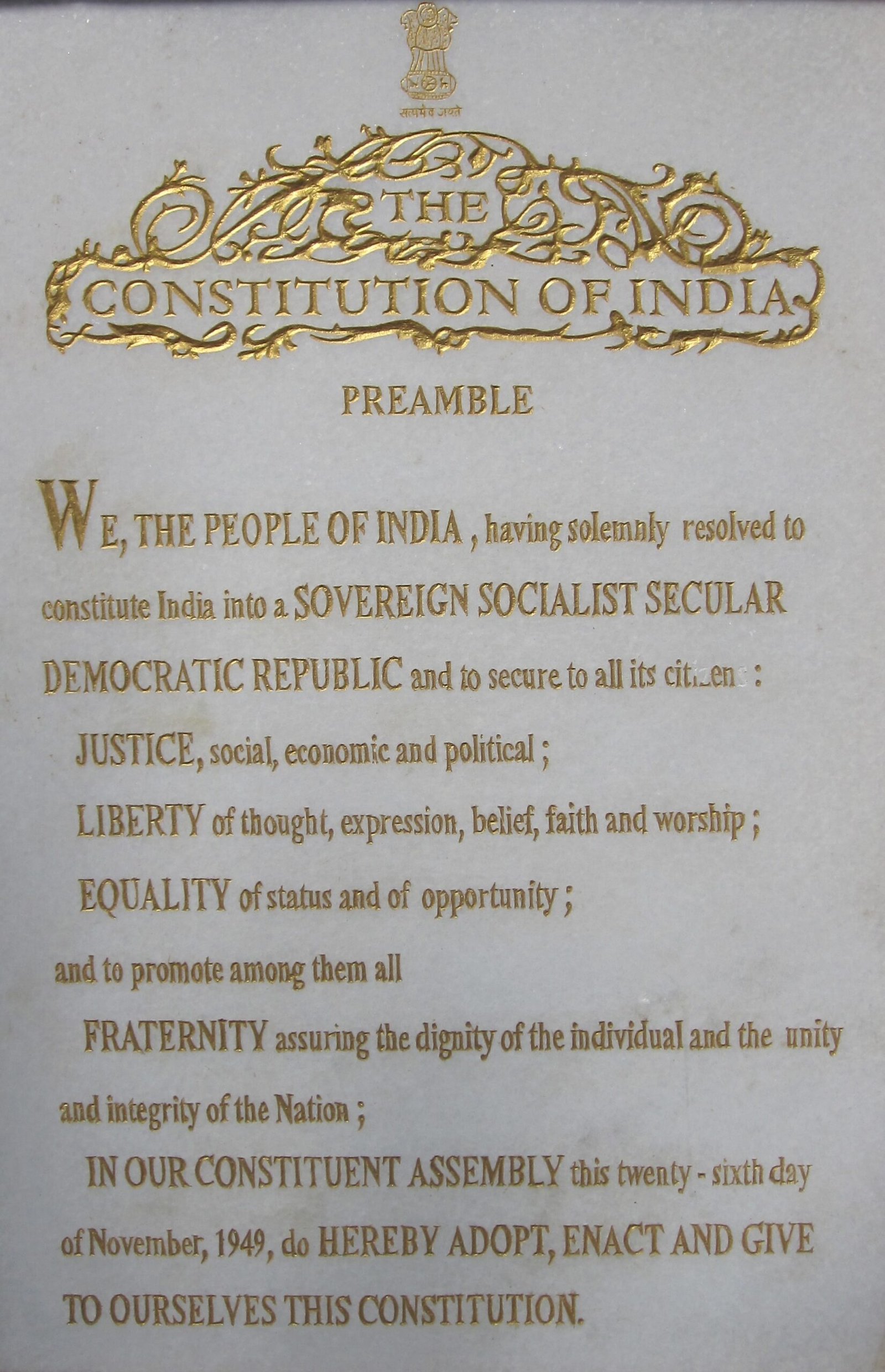
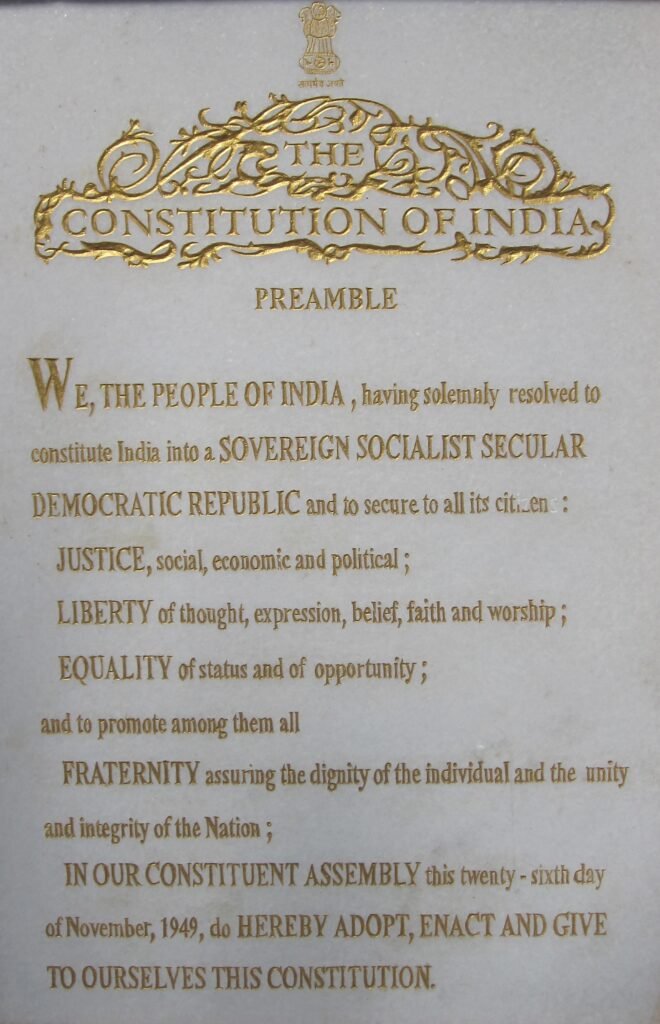
Image: Preamble of the Constitution of India. Source: Wikimedia Commons, CC0 1.0 Universal Public Domain Dedication.
Table of Contents
Important idea: Being 18 and being eligible for a particular activity are related, but they are not always the same legal question. Always check the law that applies to the specific purpose.
What Is the Age of Majority in India?
Under Section 3 of the Majority Act, 1875, every person domiciled in India attains the age of majority on completing 18 years and not before. Section 3 also explains how the age is computed: the day on which the person was born is included as a whole day, and the person is deemed to attain majority at the beginning of the eighteenth anniversary of that day.
This is the starting point for many questions about legal adulthood. It is different from simply asking how old somebody appears to be. A person’s exact date of birth is therefore important when the issue is close to an age boundary.
| Question | General answer |
|---|---|
| Age of majority in India | 18 years |
| How is majority computed? | Under the Majority Act’s statutory method, with the birth day included as a whole day |
| Is every legal age rule 18? | No. Different laws can use different age thresholds |
| Does an age calculator replace proof of age? | No. It calculates age; official records establish identity and date of birth |
The official text of the Majority Act is available through India Code — The Majority Act, 1875.
What Changes When You Turn 18?
Turning 18 can change your legal position in important ways, but the change depends on the activity. Some consequences flow from the general age of majority, while others come from separate statutes. A useful way to think about it is: 18 is a legal milestone, not a universal switch for every rule in India.
- You reach the general age of majority under the Majority Act.
- You become old enough for voter registration subject to the Representation of the People Act and the Election Commission’s qualifying-date rules.
- Age of majority becomes relevant when the law tests capacity to contract, together with the other conditions in the Indian Contract Act.
- You stop being a “child” for statutes whose definition is expressly tied to being below 18, such as the POCSO framework.
- Some age-restricted applications, licences or services become available, but the specific law may still use a different minimum or maximum age.
That last point is where many people get confused. Turning 18 does not automatically make you eligible for every job, exam, marriage, driving category, financial product or government benefit. Eligibility is always controlled by the rule that applies to that particular activity.
Age of Majority vs Other Age Limits in India
The table below shows why an 18th birthday should be treated as a starting point for checking the applicable law rather than as a universal answer.
| Purpose | Age rule | What to remember |
|---|---|---|
| General age of majority | 18 years | Set by the Majority Act, 1875 |
| Voter registration | 18 years on the relevant qualifying date | Election Commission currently recognises 1 January, 1 April, 1 July and 1 October as qualifying dates |
| Contract capacity | Age of majority + other legal conditions | Section 11 also refers to sound mind and absence of legal disqualification |
| POCSO definition of child | Below 18 years | The Act treats a person below 18 as a child for its protective framework |
| Marriage under the PCMA | 18 for a female; 21 for a male | Marriageable age is a separate legal question |
| Motor vehicle driving | Class-specific | The Motor Vehicles Act contains different thresholds, including 18 for general motor vehicles, 16 for a limited two-wheeler category, and 20 for transport vehicles |
| Bank accounts | Not automatically restricted to adults | RBI guidance permits minor deposit accounts, with conditions for independent operation |
| Aadhaar | Not an 18+ document | UIDAI allows enrolment of children, including newborn babies |
| PAN | Not simply an 18+ number | A minor can have PAN-related records, while the current Instant e-PAN service excludes minors |
The point is not to memorize all of these rules at once. It is to avoid the common mistake of taking one age threshold and applying it to a completely different legal purpose.
Voting Age: When Can You Register as a Voter?
India’s voting rules provide a good example of why the exact date matters. The Election Commission of India states that a person must be an Indian citizen, be 18 years or more of age with reference to the applicable qualifying date, be ordinarily resident in the relevant area and not otherwise be disqualified.
The Election Commission currently lists 1 January, 1 April, 1 July and 1 October as the four qualifying dates. It also explains that a citizen who has completed or will complete 18 years on one of those qualifying dates can submit an advance Form 6 application during the relevant registration process.
- Age: 18 years with reference to a qualifying date.
- Citizenship: Indian citizenship is required for registration as a general elector.
- Residence: You must ordinarily reside in the relevant polling area.
- Form: Form 6 is used for new general-voter registration.
For current voter-registration instructions, use the Election Commission of India voter-registration guidance. The site’s existing Voter ID Age Limit in India guide also explains the four qualifying dates in practical terms.

Image: Parliament House, New Delhi, 1926. Source: Wikimedia Commons, CC0 1.0 Universal Public Domain Dedication.
Contracts and the Meaning of Legal Capacity
Turning 18 matters for contract law because Section 11 of the Indian Contract Act, 1872 says that a person is competent to contract when the person is of the age of majority according to the applicable law, is of sound mind, and is not disqualified from contracting by law.
So the shortcut “I am 18, therefore every contract is valid” is too broad. Age of majority is one part of the legal test. Other requirements can still matter depending on the agreement and the surrounding facts.
You can read the statutory provision in India Code — Indian Contract Act, 1872.
Does Turning 18 Change Your Status Under Child-Protection Laws?
The answer depends on the statute, but some major child-protection laws use an under-18 definition. The Ministry of Women and Child Development has reiterated that the Protection of Children from Sexual Offences (POCSO) Act, 2012 defines a child as a person below 18 years of age.
This is a useful reminder that legal definitions are purpose-specific. A person can be a major under the Majority Act while another law separately establishes an age threshold for a particular protection, offence or eligibility rule. Never assume that a general rule of majority automatically answers every question about being a “child” or “adult” under another statute.
For current government material on this point, see the Ministry of Women and Child Development / PIB explanation of the POCSO framework.
Is the Marriage Age the Same as the Age of Majority?
No. This is one of the most important distinctions to remember. Under the Prohibition of Child Marriage Act, 2006, the statutory definition of “child” uses below 21 years for a male and below 18 years for a female. That is a marriage-specific rule; it does not change the general age of majority under the Majority Act.
In other words, an 18-year-old can be a major under the general law of majority while the applicable marriage rule for a male still uses 21. This is exactly why the question “What is the legal age?” is incomplete unless you say legal age for what?
For a dedicated explanation, see the site’s Marriage Age in India 2026 guide. The underlying statute is available from India Code — Prohibition of Child Marriage Act, 2006.
Driving Age: Why 18 Is Not the Whole Answer
The Motor Vehicles Act is another good example. Section 4 generally prevents a person under 18 from driving a motor vehicle in a public place, but it also contains separate provisions for certain vehicle categories. The law provides an exception for a motor cycle with engine capacity not exceeding 50cc from age 16, subject to the statutory conditions, and says a person under 20 cannot drive a transport vehicle in a public place, subject to the Act’s provisions.
So reaching 18 can matter for many ordinary driving-licence questions, but the exact class of vehicle still matters. Before applying for a learner or driving licence, check the vehicle category and the current licensing rules rather than relying only on the general age-of-majority rule.
For the site’s practical breakdown of learner-licence and vehicle-age rules, see Driving Licence Age Limit in India 2026. The statutory source is India Code — Motor Vehicles Act, 1988.
Can a Minor Have a Bank Account, Aadhaar or PAN?
Yes, depending on the service and its specific rules. The existence of a financial or identity document does not by itself prove that someone has reached the age of majority. Several important services are available to minors under their own rules.
- Bank account: RBI guidance permits deposit accounts to be opened in the name of a minor through a natural or legally appointed guardian, and minors above 10 may be allowed to operate savings accounts independently, subject to the bank’s risk-management limits and conditions.
- Aadhaar: UIDAI’s 2026 handbook states that children, including newborn babies, can enrol for Aadhaar.
- PAN: The Income Tax Department’s current Instant e-PAN service excludes minors from that particular service, but that does not mean a minor can never have PAN-related records through the applicable tax process.
The site’s existing guides cover the practical age-related rules for bank accounts, Aadhaar and PAN. The key lesson is simple: having a document before 18 does not mean that every adult right or legal capacity begins before 18, and turning 18 does not make every document newly available.
For current primary sources, see the Reserve Bank of India’s guidance on minor deposit accounts, UIDAI’s Aadhaar Handbook 2026, and the Income Tax Department’s Instant e-PAN FAQ.
How to Check Your Exact Age on Your 18th Birthday
When a right or eligibility condition depends on an exact age, use the date of birth shown on the document that the relevant authority accepts. Then compare that date with the date specified by the law, application form or registration process.
- Find your exact date of birth from a reliable official record.
- Write down the date on which the age must be checked.
- Calculate the completed age on that date.
- Read the rule that applies to the specific purpose, such as voting, a licence, a recruitment form or a legal document.
- Check whether that rule has a cutoff date, qualifying date, upper-age limit, relaxation or another special condition.
- Use the authority’s official instructions when an application is close to an age boundary.
For a quick date-based calculation, you can use the site’s Age Calculator. It can calculate age from a date of birth to a selected reference date, but the resulting number is not itself official proof of age.
Example: When Exactly Do You Become 18?
Suppose a person was born on 20 September 2008. Under the Majority Act’s statutory rule, the person reaches the age of majority at the beginning of the eighteenth anniversary of that date, meaning the legal age-of-majority milestone falls on 20 September 2026.
Now change the birth date to 21 September 2008. The person does not reach the eighteenth anniversary until 21 September 2026. That one-day difference can matter if an application, registration or other legal event has a hard cutoff on 20 September.
This is why “I am 18 in 2026” is not precise enough for a boundary-date decision. The relevant question is usually “Have I reached the required age on the date the law specifies?”
What Does Not Automatically Happen at 18?
- You do not automatically qualify for every government job. Recruitment notices can specify their own minimum and maximum age, cutoff date and relaxations.
- You do not automatically meet every exam or admission requirement. Many examinations use programme-specific age, qualification and passing-year rules.
- You do not automatically become eligible to marry at 18 in every context. Marriage law has its own statutory thresholds.
- You do not automatically qualify for every driving category at 18. Vehicle class and transport-vehicle rules can change the relevant age.
- You do not replace official age documents with an online calculation. A calculator is useful for checking a date calculation, not for proving identity or date of birth.
This distinction is particularly important for government applications. The site’s Government Job Age Limit in India guide and individual recruitment articles show why candidates must check the exact cutoff date used by each notification rather than simply checking whether they have turned 18.
Common Misunderstandings About the Age of Majority
“All legal ages in India are 18.”
False. Eighteen is the general age of majority, but laws for marriage, driving, voting, employment, education and other activities can use different thresholds or additional conditions.
“My birth year is enough to calculate whether I am 18.”
Not for an exact cutoff. Month and day can make the difference. A person born late in the year may still be below an age threshold even though the birth year appears to match the expected range.
“If I can get a PAN or Aadhaar, I am legally an adult.”
No. Government documents and services can be available to minors under separate rules. The legal age of majority is a different concept from the age at which a particular document or service can be issued.
“An online age calculator is legal proof.”
No. It is a calculation aid. For official purposes, use the date-of-birth proof and identity documents accepted by the relevant authority.
18th-Birthday Checklist: What to Verify
- Confirm your date of birth: Make sure your key records do not contain conflicting dates.
- Check voter eligibility: Look at the current Election Commission qualifying-date rules.
- Review age-based applications: Read the specific eligibility section of the form, not just a general age article.
- Keep documents ready: Have the official DOB and identity records required for the service.
- Check cutoff dates carefully: If you are one day short of an age threshold, the difference can be decisive.
- Use an exact-age calculator as a cross-check: Calculate the age to the relevant date rather than relying on a rough year-to-year subtraction.
Why the Exact Date of Birth Matters
Many eligibility mistakes happen because people treat age as a simple subtraction problem. For an age boundary, however, the exact date can matter as much as the year. This is true when you are turning 18, when a recruitment notice sets an upper-age cutoff, or when an authority uses a qualifying date for registration.
Our Age Calculator for Forms guide explains how to enter age and date of birth correctly, while the site’s Chronological Age Calculator guide explains the difference between calendar age and an exact elapsed age calculation.
Frequently Asked Questions
What is the age of majority in India in 2026?
The general age of majority is 18 years under the Majority Act, 1875 for persons domiciled in India.
Does a person become a major on the 18th birthday?
Yes. Section 3 of the Majority Act states that majority is attained at the beginning of the eighteenth anniversary of the person’s birth date, using the statutory method set out in the Act.
Can I register as a voter before I turn 18?
The Election Commission allows advance applications in the relevant registration process for eligible citizens who have completed or will complete 18 on one of the four qualifying dates: 1 January, 1 April, 1 July or 1 October.
Is the legal marriage age the same as the age of majority?
No. Marriage law uses its own statutory thresholds. Under the Prohibition of Child Marriage Act, the relevant child definition is based on below 18 for a female and below 21 for a male.
Can a minor have Aadhaar, PAN or a bank account?
Yes, depending on the service and its specific rules. For example, UIDAI permits child Aadhaar enrolment, RBI guidance permits minor deposit accounts, and the Income Tax Department’s current Instant e-PAN service separately excludes minors.
Can an age calculator prove that I am legally 18?
No. An age calculator can check the arithmetic from your date of birth to a reference date. Official documents and the authority’s applicable rules are what you should rely on for legal or administrative verification.
Official Sources and Useful Guides
- India Code — Majority Act, 1875
- Election Commission of India — voter registration
- India Code — Indian Contract Act, 1872
- India Code — Prohibition of Child Marriage Act, 2006
- India Code — Motor Vehicles Act, 1988
- Reserve Bank of India — minor deposit accounts
- UIDAI — Aadhaar Handbook 2026
- Income Tax Department — Instant e-PAN FAQ
- PIB / Ministry of Women and Child Development — POCSO overview
For practical age checks, you can also use the site’s Age Calculator, Age Calculator for Forms, Voter ID Age Limit guide and Marriage Age in India guide.
Final Takeaway
The age of majority in India is 18 years under the Majority Act, 1875. That is the general legal milestone, but it should never be used as a substitute for checking the rule that applies to a specific activity. Voting has qualifying-date rules, contract capacity includes additional requirements, child-protection laws can define a child by being below 18, marriage uses separate minimum ages, and driving depends on the vehicle category and statutory conditions.
The safest approach is straightforward: use your exact date of birth, identify the law or authority that controls the situation, check the relevant cutoff or qualifying date, and then verify the requirement with the current official source. An age calculator is useful for the date arithmetic, but official documents and the applicable authority remain the final reference for legal and administrative purposes.
Disclaimer: This article is for general information and practical age-checking guidance. It is not legal advice for an individual case. Laws, official procedures and eligibility requirements can change, so confirm important decisions with the latest primary-source guidance from the responsible government authority or a qualified legal professional.


