
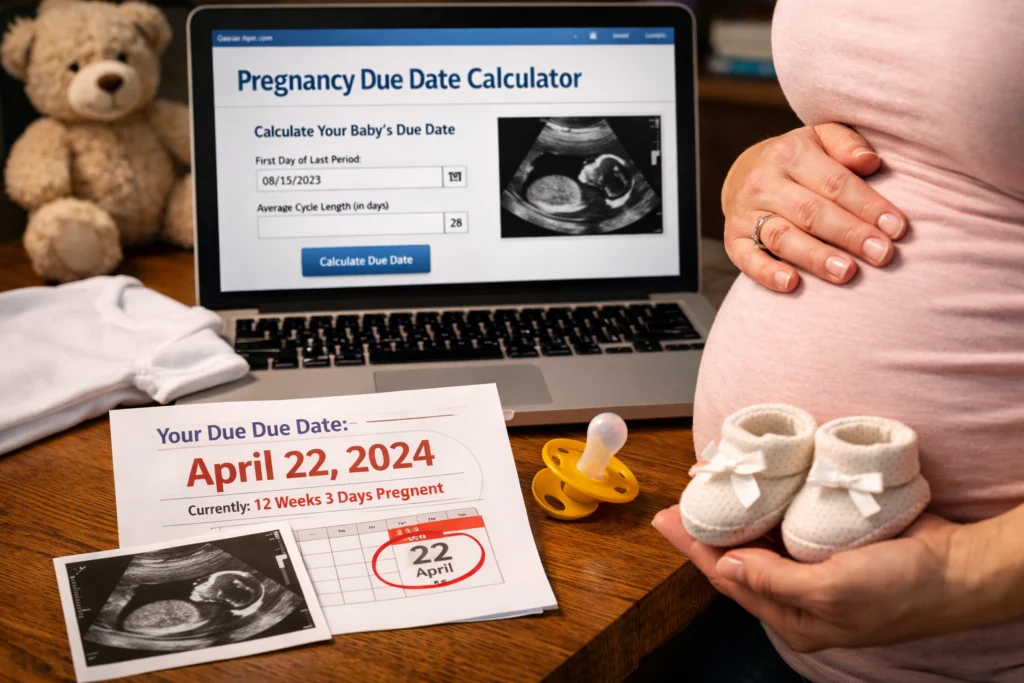
A pregnancy due date calculator helps expectant mothers estimate their baby’s delivery date based on important factors like the last menstrual period or conception date. It is a simple and reliable way to track pregnancy progress and prepare for your baby’s arrival.
Knowing your due date helps you plan medical visits, monitor your pregnancy stages, and get ready for childbirth. This guide explains how due dates are calculated and how you can use a simple calculator to find your expected delivery date.
Table of Contents
- What Is Pregnancy Due Date
- How Pregnancy Due Date Calculator Works
- How to Calculate Pregnancy Due Date
- Due Date Based on Last Period
- Due Date Based on Conception Date
- Pregnancy Trimester Breakdown
- How Accurate Is a Due Date Calculator
- Signs Your Baby Is Coming Soon
- When Will My Baby Be Born
- Who Should Use This Tool
- Conclusion
What Is Pregnancy Due Date
Pregnancy due date refers to the estimated date when a baby is expected to be born. It is usually calculated based on the mother’s last menstrual period or conception date.
Doctors use this estimated date to monitor pregnancy progress and ensure that both mother and baby remain healthy throughout the pregnancy journey.
How Pregnancy Due Date Calculator Works
The pregnancy due date calculator works by taking key inputs such as the first day of your last menstrual period or conception date. Based on this information, it calculates your estimated delivery date.
The calculator uses a standard pregnancy duration of 40 weeks (280 days) to estimate the due date.
How to Calculate Pregnancy Due Date
Pregnancy due date is usually calculated by adding 280 days (40 weeks) to the first day of your last menstrual period.
This method is widely used by healthcare professionals and provides a reliable estimate for most pregnancies.
What Is the Average Pregnancy Duration
The average pregnancy duration is around 40 weeks or 280 days from the first day of the last menstrual period. This duration is considered full-term pregnancy.
However, babies may be born earlier or later depending on individual conditions, and both scenarios can still be normal.
Due Date Based on Last Period
Calculating due date based on the last menstrual period is the most common method. It assumes a regular menstrual cycle and uses the first day of your last period as the starting point.
This method is simple and widely accepted in medical practice.
Due Date Based on Conception Date
If you know your exact conception date, your due date can also be calculated by adding 266 days (38 weeks) from that date.
This method is useful for those who track ovulation or use fertility treatments.
What Affects Your Pregnancy Due Date
Several factors can influence your estimated due date. While calculators provide a general estimate, each pregnancy is unique and may vary slightly.
- Irregular menstrual cycles
- Ovulation timing
- Health conditions
- Multiple pregnancies (twins or more)
- Lifestyle and stress levels
These factors can cause slight differences in the expected delivery date, which is why doctors monitor pregnancy regularly.
Pregnancy Trimester Breakdown
| Trimester | Weeks |
|---|---|
| First | 1–12 |
| Second | 13–26 |
| Third | 27–40 |
Each trimester represents a stage of pregnancy, with specific developments for both the baby and the mother.
How Accurate Is a Due Date Calculator
A pregnancy due date calculator provides an estimated date, but actual delivery may vary. Most babies are born within a week before or after the expected due date.
Factors such as health conditions, lifestyle, and pregnancy complications can affect the exact delivery date.
Why Tracking Pregnancy Weeks Is Important
Tracking pregnancy weeks helps you understand your baby’s development at each stage. It also allows doctors to monitor growth and detect any potential issues early.
Using a pregnancy due date calculator along with weekly tracking provides better insights into your pregnancy journey.
Signs Your Baby Is Coming Soon
- Regular contractions
- Lower back pain
- Water breaking
- Increased pelvic pressure
These signs indicate that labor may begin soon, and medical attention should be sought immediately.
How to Prepare for Your Baby’s Arrival
- Pack your hospital bag in advance
- Schedule regular medical checkups
- Prepare baby essentials like clothes and diapers
- Plan transportation for hospital visits
Proper preparation helps reduce stress and ensures a smooth experience during labor and delivery.
When Will My Baby Be Born
Most babies are born within a week before or after the estimated due date, as it is only an approximate calculation.
Who Should Use This Tool
- Expectant mothers
- Couples planning pregnancy
- Healthcare awareness seekers
Useful Age Calculators
For medical information, visit World Health Organization.
Why Use an Online Pregnancy Due Date Calculator
Online tools make it easy to calculate your expected delivery date instantly. Instead of manual calculations, these tools provide quick and reliable results.
A pregnancy due date calculator helps expectant mothers stay informed, plan ahead, and track their pregnancy more effectively.
Conclusion
The pregnancy due date calculator is a helpful tool that allows you to estimate your baby’s delivery date and plan your pregnancy journey effectively. While the result is an estimate, it provides a useful guideline for tracking progress and preparing for childbirth.
How is a pregnancy due date calculated?
A pregnancy due date is usually calculated by adding 280 days (40 weeks) to the first day of the last menstrual period. This is the most common method used by healthcare professionals.
Can I calculate my baby due date without a calculator?
Yes, you can calculate your due date manually by adding 40 weeks to the first day of your last period. However, using an online tool makes the process faster and more accurate.
How accurate is a pregnancy due date estimate?
A due date estimate is not exact. Most babies are born within a week before or after the calculated date, as it is only an approximation.
Can ultrasound change the due date?
Yes, an ultrasound can adjust the estimated due date, especially in early pregnancy, as it provides more accurate measurements of the baby’s growth.
What factors can affect the delivery date?
Factors such as irregular menstrual cycles, health conditions, lifestyle, and pregnancy complications can influence the actual delivery date.
When should I start tracking my pregnancy due date?
You should start tracking your due date as soon as pregnancy is confirmed. Early tracking helps in better planning and monitoring of pregnancy progress.