

In India, 60 years is the most important general age threshold for being treated as a senior citizen, but there is no single “senior citizen rule” that controls every service, tax provision, scheme or financial product. The exact definition depends on the law or programme you are checking.
For example, the Maintenance and Welfare of Parents and Senior Citizens Act, 2007 defines a senior citizen as an Indian citizen who has attained 60 years or above. The Income Tax Department also uses 60 as the senior-citizen threshold for its tax framework, while 80 years is the threshold for a “super senior citizen” for income-tax purposes. Other schemes can have their own eligibility conditions.
This guide explains senior citizen age in India in 2026, what changes at 60, what changes at 80, how exact age should be checked, and why turning 60 does not automatically create eligibility for every senior-citizen benefit.

Image: Rashtriya Vayoshri Yojana launch, Venkatachalam, Andhra Pradesh, 1 April 2017. Source: Wikimedia Commons; Ministry of Social Justice and Empowerment / PIB; Government Open Data License (GODL-India).
Quick answer: In the main statutory and income-tax contexts, 60 years is the key senior-citizen threshold. For income-tax purposes, a resident individual who is 60 or older but below 80 during the relevant previous year is a senior citizen; 80 or older is treated as super senior citizen. Other schemes may apply their own age, residence, income, retirement or documentation conditions.
What Is the Senior Citizen Age in India?
The clearest statutory definition comes from the Maintenance and Welfare of Parents and Senior Citizens Act, 2007. Section 2(h) defines a “senior citizen” as an Indian citizen who has attained the age of sixty years or above.
This definition is important because it is tied to a specific welfare and maintenance law. It does not mean that every government programme, bank product or concession must use exactly the same eligibility test. When you are applying for a benefit, always read the definition used by that particular authority.
| Age | Common legal or tax classification | Important qualification |
|---|---|---|
| Below 60 | Generally not a senior citizen under the 2007 senior-citizen welfare law | A separate scheme can still have its own age rule |
| 60 to below 80 | Senior citizen for income-tax purposes when the statutory conditions are met | Income-tax treatment can depend on residency and the relevant previous year |
| 80 or above | Super senior citizen for income-tax purposes | The 80-year classification is specific to the tax framework |
| 60 or above | Senior citizen under the Maintenance and Welfare of Parents and Senior Citizens Act | The Act applies to its own maintenance and welfare framework |
The statutory source is available through India Code — Maintenance and Welfare of Parents and Senior Citizens Act, 2007.
Do You Become a Senior Citizen on Your 60th Birthday?
For an age rule expressed as “60 years or above,” the practical starting point is your exact date of birth. If your 60th birthday has arrived, you have completed 60 years. But some programmes use a reference date, a previous-year test, a cutoff date or an additional condition instead of simply asking your age today.
For example, the Income Tax Department says that a resident individual who is 60 years or above but below 80 at any time during the previous year is a senior citizen for income-tax purposes. That is different from a scheme that might say “60 years or above as on the application date.”
- Birth date: Start with the exact date shown in the accepted proof of date of birth.
- Reference date: Check the date on which the applicable rule measures age.
- Completed age: Do not assume that the birth year alone proves that you have reached 60.
- Special definition: Read the authority’s own definition if it uses a different age or another eligibility condition.
For general date calculations, the site’s Age Calculator can help you calculate completed age from your date of birth to a selected reference date. The calculation is a convenience tool; official documents remain the proof used by authorities.
Senior Citizen vs Super Senior Citizen: What Changes at 80?
The terms senior citizen and super senior citizen are particularly important in income-tax matters. For Assessment Year 2026-27, the Income Tax Department states that a resident individual who is 60 years or above but less than 80 years at any time during the previous year is a senior citizen. A resident individual who is 80 years or above at any time during the previous year is a super senior citizen.
This means that 80 is not a replacement for 60. It is a second age band within the tax framework. Someone aged 67 is a senior citizen for the relevant tax rules; someone aged 82 falls into the super-senior category for those rules.
| Age during the relevant previous year | Income-tax label |
|---|---|
| Under 60 | Non-senior citizen |
| 60 to 79 | Senior citizen |
| 80 and above | Super senior citizen |
See the current Income Tax Department guidance for senior and super senior citizens before making a tax decision, because the applicable provisions depend on the assessment year, tax regime and the taxpayer’s circumstances.
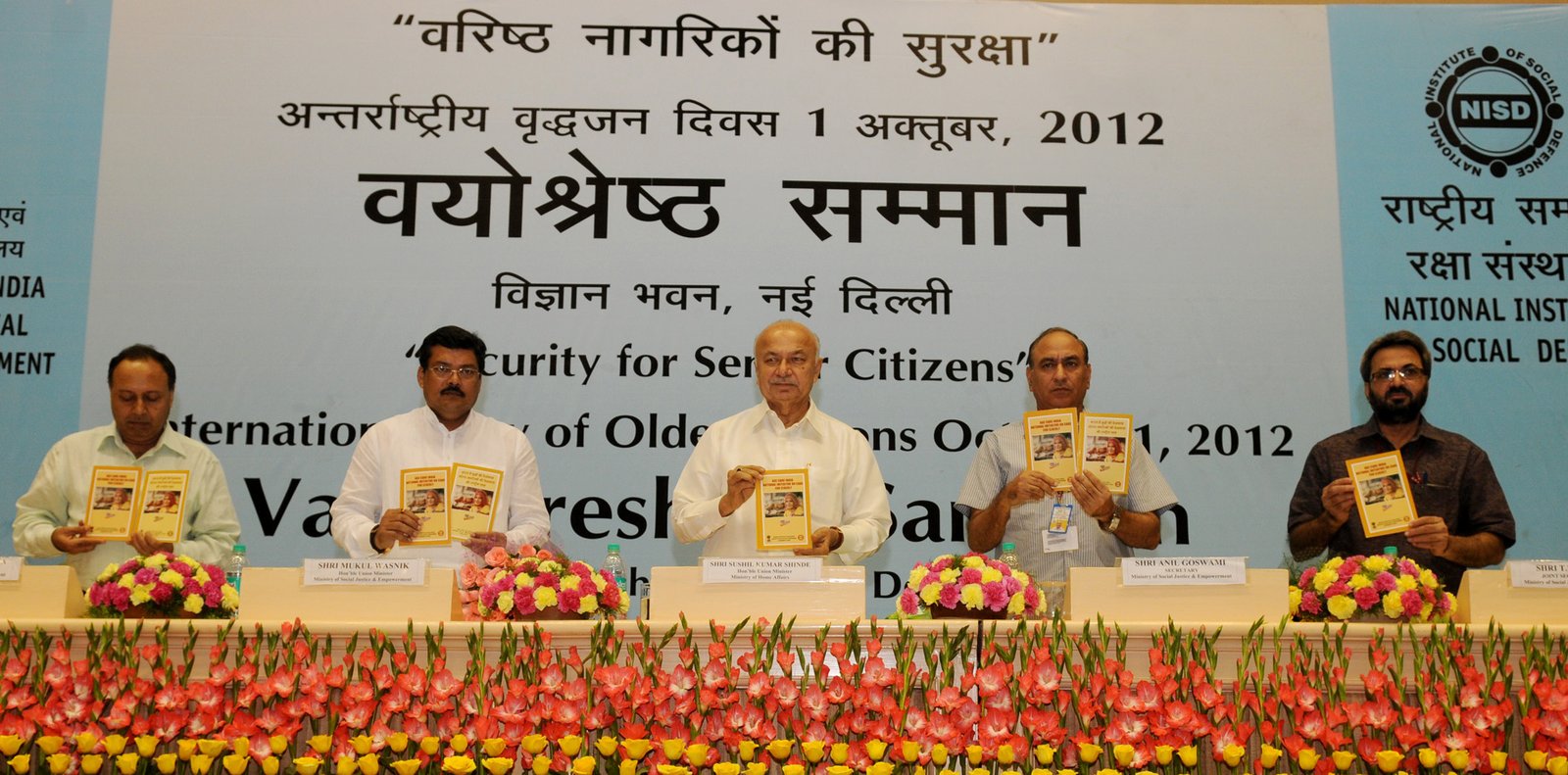
Image: Vayoshreshtha Samman presentation for selected senior citizens, New Delhi, 1 October 2012. Source: Wikimedia Commons; Ministry of Social Justice and Empowerment / PIB; Government Open Data License (GODL-India).
What Tax Benefits Can Apply After Age 60?
Age 60 can affect several income-tax provisions, but these should not be described as a universal “senior citizen discount.” The applicable benefit depends on the section, the taxpayer’s residence, the tax regime and other conditions.
- Section 80TTB: The Income Tax Department’s current senior-citizen guidance describes a deduction of up to ₹50,000 for interest on eligible deposits for resident senior citizens, subject to the applicable conditions and tax regime.
- Advance tax: The Department explains that a resident senior citizen who does not have income from business or profession is relieved from advance-tax payment under the relevant provisions, subject to the statutory conditions.
- Medical-related provisions: The tax framework can provide higher limits for certain medical-insurance premiums and specified medical expenditure involving senior citizens under the applicable sections.
- Super-senior treatment: Some filing provisions provide additional options for people aged 80 or above, such as the paper-filing option described by the Income Tax Department.
These provisions should be checked against the current tax year and the taxpayer’s circumstances. Do not assume that turning 60 automatically makes every tax benefit available, especially if you are using the new tax regime or have business or professional income.
Does Age 60 Automatically Make You Eligible for Senior-Citizen Schemes?
No. Age is often only the first eligibility test. A scheme can add income limits, retirement status, citizenship, residence, account ownership, employment history, family conditions, investment limits or other requirements.
The Senior Citizens Savings Scheme (SCSS) guide, for example, covers a specific savings product with its own eligibility routes and rules. It should not be treated as the definition of “senior citizen” for every other purpose.
Similarly, the site’s Kisan Credit Card age-limit guide shows how a financial product can use its own age range and additional co-borrower conditions for senior applicants. The existence of that rule does not create a universal KCC-style age test for all senior citizens.
Senior Citizen Age and Bank Accounts or Deposits
Banks can offer special treatment or products for senior citizens, but the exact age and product conditions should be checked with the bank. This is different from the question of whether a person can have a bank account at all.
In fact, age 60 is not a general minimum age for having a bank account. Minors can have accounts under applicable banking rules, and the site’s Bank Account Age Limit in India guide explains the separate rules for minor accounts.
For a senior citizen, the important question is therefore not “Can I open a bank account after 60?” but “Does this bank or deposit product provide a senior-citizen category, and what age, documentation and product conditions apply?”
Senior Citizen Age and Life Insurance
Turning 60 also does not create one universal life-insurance rule. Life-insurance products can specify their own minimum entry age, maximum entry age, policy term and maturity-age limits.
The site’s current Life Insurance Age Limit in India 2026 guide explains this product-specific approach. An insurer may accept an older applicant for one product while using a lower maximum entry age for another.
This is an important distinction: senior-citizen status is a legal or administrative classification, while insurance entry age is a product eligibility condition. One should not be used as a substitute for the other.
Senior Citizen Age Under the Parents and Senior Citizens Welfare Law
The Maintenance and Welfare of Parents and Senior Citizens Act is not simply a discount or benefits law. It creates a framework for the maintenance and welfare of parents and senior citizens. The Act defines a senior citizen as an Indian citizen aged 60 years or above.
The law also contains provisions concerning maintenance applications and the responsibilities of children or, in specified circumstances, relatives. A senior citizen who is unable to maintain himself or herself from earnings or property can use the statutory mechanism subject to the Act’s conditions.
For an individual legal dispute, however, the statute should be read together with the current rules and the applicable state or tribunal procedure. An online article is not a substitute for legal advice on a specific case.
Are Senior-Citizen Benefits the Same Across India?
No. India has central laws and programmes as well as state-specific schemes. A state pension, transport concession, healthcare programme or local welfare benefit can use its own age threshold and additional eligibility conditions.
The Ministry of Social Justice and Empowerment’s information on Atal Vayo Abhyuday Yojana and senior-citizen welfare shows the wider policy framework for improving the quality of life of senior citizens. Such programmes can involve food, shelter, healthcare, protection, active ageing and other forms of support, with eligibility and implementation depending on the particular programme and implementing agency.
Therefore, “I am 60, so I automatically get every senior-citizen benefit” is not a safe assumption. The correct approach is to identify the exact benefit and then check its current eligibility notice.
Does Senior-Citizen Status Affect Aadhaar, PAN or Passport?
Not in the sense of creating a general “senior citizen document.” Aadhaar, PAN and passports are governed by their own rules. Age can matter to specific services, fees, validity periods or verification requirements, but turning 60 does not create a new identity document called a senior-citizen card under one universal central rule.
For example, the site’s PAN Card Age Limit guide explains that minors can have PAN-related records and that PAN itself is not limited to adults. Likewise, its Passport Age Limit guide explains that passport rules distinguish between minors and adults rather than using 60 as the general passport threshold.
How to Calculate Whether You Have Reached Age 60
Use the exact date of birth and the reference date specified by the relevant rule. Do not calculate age by simply subtracting the birth year from the current year when a hard age boundary is involved.
- Take the exact date of birth from the document accepted by the authority.
- Identify the date on which the applicable law or scheme checks age.
- Calculate the completed age on that date.
- Check whether the rule says “60 or above,” “completed 60 years,” “60 as on a particular date,” or uses another formulation.
- Check additional conditions such as residence, income, retirement status, citizenship or account type.
- Keep the official DOB document ready for verification.
For a detailed explanation of exact age calculation, see the site’s Chronological Age Calculator guide and Age Calculator for Forms guide.
Example: Who Is a Senior Citizen in 2026?
Suppose a person was born on 20 September 1966. The person completes 60 years on 20 September 2026. For a rule that simply requires the person to have attained 60 years, the 60th birthday is the relevant milestone.
Now consider a person born on 21 September 1966. That person completes 60 years on 21 September 2026. If a scheme has a cutoff of 20 September 2026, the second person has not yet completed 60 on the cutoff date even though both people were born in the same calendar year.
For tax purposes, the test can be framed differently because the Income Tax Department looks at whether the person was 60 or above at any time during the previous year. This is why the same birthday can have different practical effects under different rules.
Common Mistakes About Senior Citizen Age
“Everyone in India becomes a senior citizen at exactly the same legal moment.”
The 60-year threshold is widely used, but the precise effect depends on the law or scheme. Some rules use a cutoff date, a previous-year test or additional eligibility conditions.
“80 is the general senior-citizen age.”
No. In the major statutory and tax contexts discussed here, 60 is the senior-citizen threshold. In income-tax terminology, 80 is the point at which the person moves into the super-senior category.
“Turning 60 automatically gives me every senior-citizen benefit.”
No. Benefits can require additional conditions such as income, residence, retirement status, investment rules, disability status, citizenship or scheme-specific documentation.
60th-Birthday Checklist for 2026
- Confirm your DOB: Check the date on your accepted official records.
- Check the purpose: Tax, pension, savings, insurance and welfare schemes can use different rules.
- Read the cutoff: Look for wording such as “as on,” “during the previous year” or “on the application date.”
- Check extra eligibility: Age alone may not be enough.
- Compare central and state rules: A state welfare programme can have different conditions from a central tax provision.
- Use exact-age calculation: If you are close to 60 or 80, calculate the age to the precise reference date.
- Keep documents ready: Online calculations do not replace official proof of age.
Frequently Asked Questions
What is the senior citizen age in India in 2026?
In the Maintenance and Welfare of Parents and Senior Citizens Act, 2007, a senior citizen is an Indian citizen who has attained 60 years or above. The Income Tax Department also uses 60 as the senior-citizen threshold, subject to its own statutory conditions.
Is 60 the senior citizen age for income tax?
Yes, for the tax classification described by the Income Tax Department, a resident individual who is 60 or older but below 80 at any time during the relevant previous year is a senior citizen. At 80 or above, the person is a super senior citizen for those tax rules.
What age is a super senior citizen in India?
For income-tax purposes, a resident individual who is 80 years or above at any time during the relevant previous year is classified as a super senior citizen.
Do senior citizens get a ₹50,000 tax deduction?
The Income Tax Department states that Section 80TTB can allow a resident senior citizen a deduction of up to ₹50,000 for eligible interest from deposits, subject to the applicable conditions and tax regime. It is not a blanket ₹50,000 payment or benefit simply for turning 60.
Does turning 60 automatically qualify me for SCSS?
No. SCSS has its own eligibility routes and conditions. Use the current scheme rules rather than treating the general 60-year senior-citizen definition as the complete SCSS eligibility test.
Can a person below 60 receive a senior-related benefit?
It depends on the benefit. Some programmes may use a different age threshold or cover a person through another eligibility route. Always check the exact scheme definition.
Official Sources and Useful Guides
- India Code — Maintenance and Welfare of Parents and Senior Citizens Act, 2007
- Income Tax Department — Senior Citizens and Super Senior Citizens for AY 2026-27
- Department of Social Justice and Empowerment — Atal Vayo Abhyuday Yojana
- SCSS Age Limit 2026 guide
- Kisan Credit Card Age Limit 2026 guide
- Life Insurance Age Limit in India 2026 guide
- Bank Account Age Limit in India 2026 guide
Final Takeaway
60 years is the key senior-citizen age in India for the statutory welfare definition and for the senior-citizen classification used by the Income Tax Department, subject to the relevant conditions. At 80, the Income Tax Department uses the separate “super senior citizen” category.
The important point is that senior-citizen status is not a universal eligibility pass. Tax provisions, savings schemes, insurance products, pensions and state welfare programmes can each have their own rules. If you are close to age 60 or 80, use your exact date of birth, identify the rule that applies to your purpose, check the relevant reference date and verify the requirement with the responsible authority.
Disclaimer: This article provides general information and is not legal, tax or financial advice for an individual case. Age thresholds, tax provisions and government schemes can change. Confirm important decisions with the latest primary-source guidance or a qualified professional.