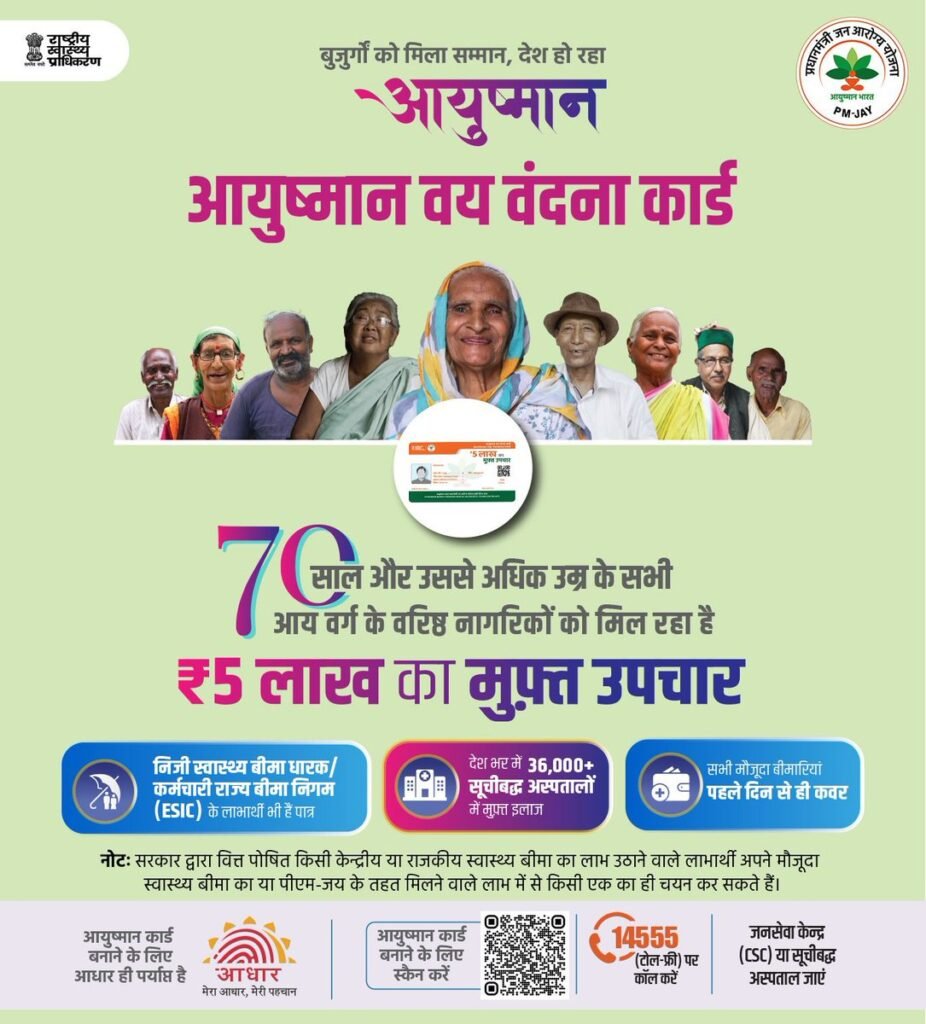
Ayushman Vay Vandana age limit 2026: Senior citizens must be 70 years or above to qualify for the dedicated Ayushman Vay Vandana Card under Ayushman Bharat Pradhan Mantri Jan Arogya Yojana (AB PM-JAY). The Government of India expanded AB PM-JAY in October 2024 to cover all senior citizens aged 70 years and above, irrespective of socio-economic status.
The age rule is important because eligibility for this senior-citizen expansion is based on the age recorded in Aadhaar. There is no separate income ceiling for the 70+ benefit. This guide explains the minimum age, DOB calculation, Aadhaar requirement, coverage, enrolment process, existing insurance rules, documents and common mistakes for 2026.
Ayushman Vay Vandana Age Limit 2026 at a Glance
| Requirement | Current rule |
|---|---|
| Minimum age | 70 years |
| Upper age limit | No separate upper age limit stated |
| Income test | No income restriction for the 70+ expansion |
| Age proof | Age recorded in Aadhaar |
| e-KYC | Aadhaar-based e-KYC is mandatory |
| Health cover | Up to ₹5 lakh per year on a family basis |
| Distinct card | Ayushman Vay Vandana Card |
The National Health Authority’s senior-citizen FAQ states that the only eligibility criterion is attaining age 70 years or above, determined from the age recorded in Aadhaar. It also states that Aadhaar-based e-KYC is mandatory for enrolment and card issuance.
Who Is Eligible for Ayushman Vay Vandana in 2026?
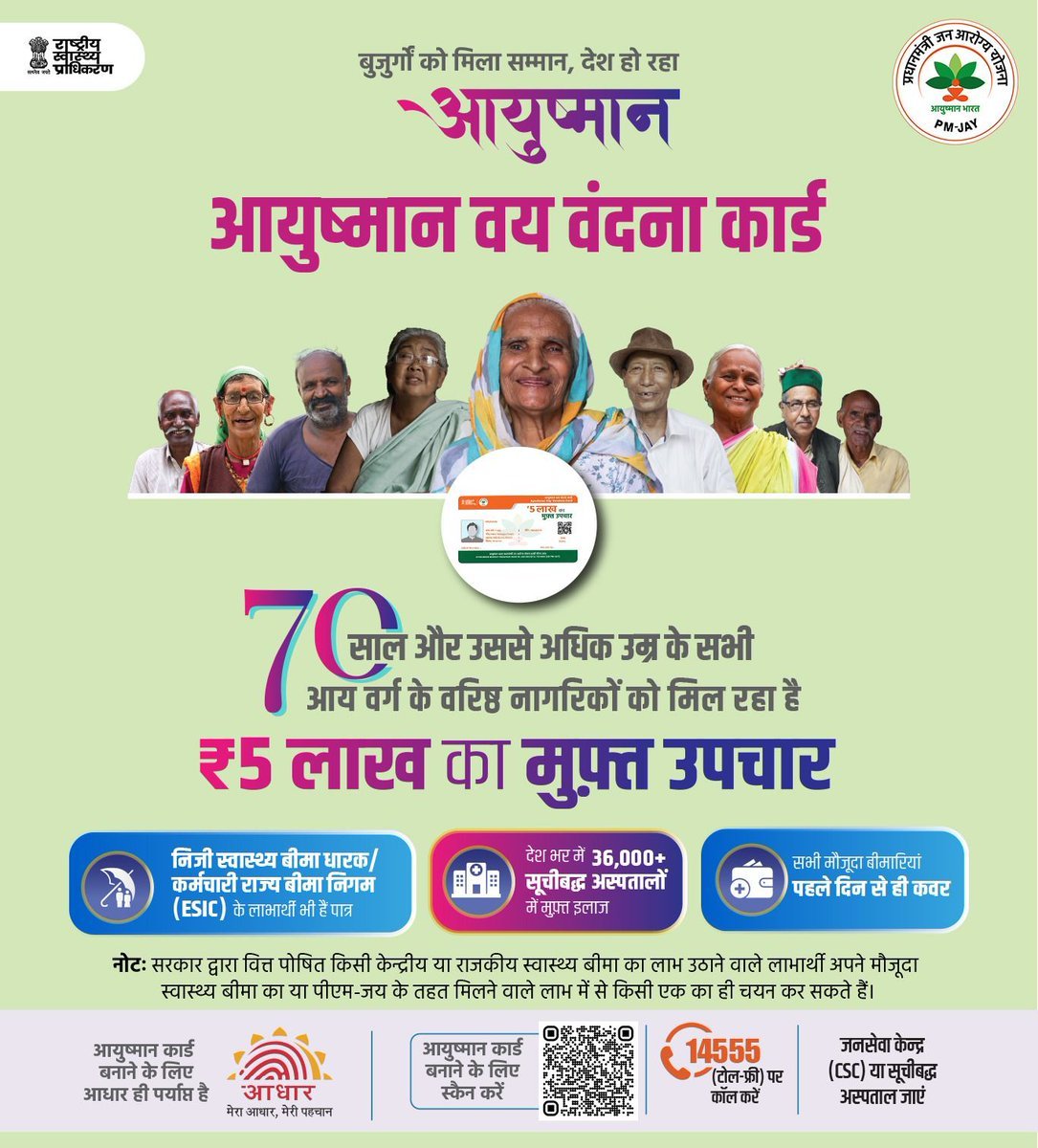
The 70+ expansion covers senior citizens who have attained 70 years of age or above. The benefit is not restricted to people below a particular income level. The official government guidance describes the expansion as available to all senior citizens aged 70 years and above irrespective of socio-economic status.
- You must be 70 years or older.
- Your eligibility age is determined from the age recorded in Aadhaar.
- Aadhaar-based e-KYC is required for enrolment and issuance of the card.
- There is no income test for this 70+ expansion.
- A distinct Ayushman Vay Vandana Card is issued to eligible senior citizens.
Is There Any Upper Age Limit?
The current senior-citizen eligibility material does not state a separate maximum age. The rule is framed as 70 years and above, so the important threshold is reaching 70 rather than staying within an upper-age window.
For example, a person aged 70, 75, 80 or 90 is not excluded merely for being older. The relevant requirement is that the person has attained the minimum qualifying age and can complete the required Aadhaar-based verification.
How Is the 70-Year Age Calculated?
Age for this benefit is determined using the age recorded in Aadhaar. This makes the Aadhaar record particularly important when a person’s actual date of birth and the date or year recorded in Aadhaar differ.
The official FAQ gives a specific rule for Aadhaar records that show only a birth year: January 1 of the year following the recorded birth year is treated as the date of birth for this purpose. Applicants should therefore check the Aadhaar record before assuming that they qualify on a particular date.
- If the Aadhaar record supports an age of 70 or above, the age criterion is met.
- If the Aadhaar record indicates an age below 70, the senior-citizen expansion does not yet apply.
- If only the birth year is recorded, use the official Aadhaar-based calculation described in the NHA FAQ.
- For an exact age check, keep the Aadhaar record and supporting DOB information consistent.
What Benefits Does the Ayushman Vay Vandana Card Provide?
Eligible senior citizens can receive health coverage of up to ₹5 lakh per year under AB PM-JAY. The government describes the benefit as free treatment coverage for eligible 70+ senior citizens, irrespective of socio-economic status.
- Up to ₹5 lakh health cover per year on a family basis.
- Coverage is available to eligible senior citizens aged 70 and above.
- Pre-existing diseases are covered from the first day under the senior-citizen benefit.
- Services are delivered through the AB PM-JAY network of empanelled hospitals.
- Portability allows eligible beneficiaries to use services across participating hospitals, subject to the scheme’s rules.
What Happens If the Family Already Has an AB PM-JAY Card?
Senior citizens aged 70 and above who belong to families already covered under AB PM-JAY receive an additional top-up cover of up to ₹5 lakh per year for themselves. This top-up is separate from the amount available to family members below 70 under the existing family coverage.
The senior citizen therefore does not simply become another ordinary member sharing the same family pool. The government has described a distinct senior-citizen benefit and card for the 70+ expansion.
What If the Senior Citizen Already Has Other Insurance?
Existing insurance status does not automatically remove eligibility in every case. The official government material states that senior citizens with private health insurance or Employees’ State Insurance can also avail AB PM-JAY benefits.
However, a senior citizen already covered by another publicly funded government health insurance scheme is required to choose between the existing government scheme and AB PM-JAY. The choice rule is different from private insurance eligibility, so applicants should check their exact existing coverage before switching.
Is Aadhaar Mandatory?
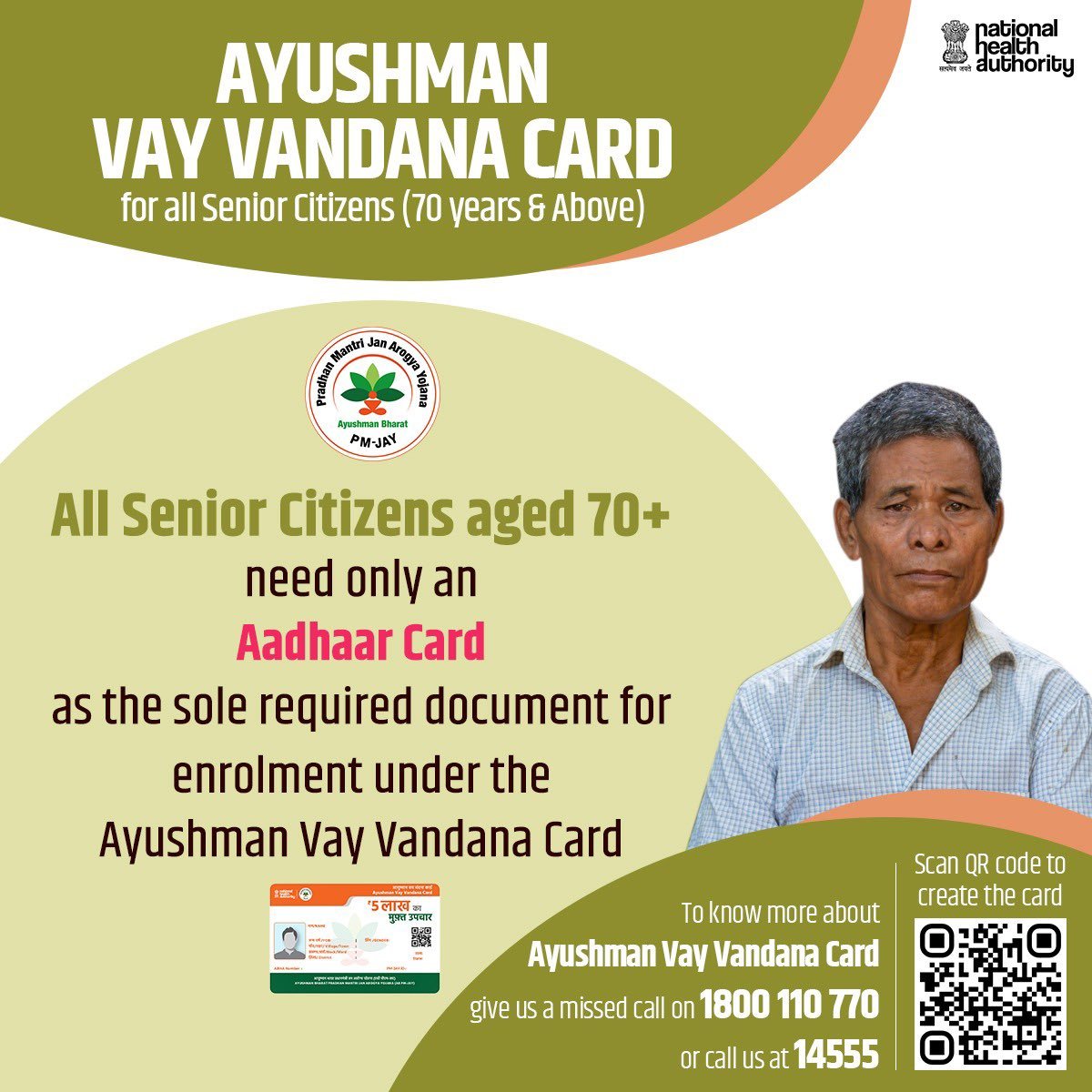
Yes. Aadhaar-based e-KYC is mandatory for enrolment and issuance of the Ayushman Vay Vandana Card. The NHA FAQ identifies Aadhaar as the document used to establish the age eligibility for the 70+ benefit.
If the Aadhaar information is incomplete or contains an age detail that does not match the person’s supporting records, it is sensible to resolve the identity or DOB issue before relying on the card-creation process.
How to Apply for the Ayushman Vay Vandana Card
Enrolment for eligible senior citizens is application-based. The official government material provides several routes, so a beneficiary does not have to rely on a single channel.
- Check that the senior citizen has attained 70 years according to the Aadhaar-recorded age.
- Keep the Aadhaar details available for Aadhaar-based e-KYC.
- Use the Ayushman App or the beneficiary portal for self-registration.
- Alternatively, visit a nearby empanelled hospital or Common Service Centre for assistance.
- Complete the identity and beneficiary verification steps.
- After successful verification, obtain the distinct Ayushman Vay Vandana Card.
Where Can Senior Citizens Enrol?
The government has listed multiple enrolment channels. Eligible people can use the Ayushman App, the beneficiary web portal, a nearby empanelled hospital or a Common Service Centre. The official helpline can also be used for assistance.
- Ayushman App for self-registration and card-related services.
- Beneficiary portal at beneficiary.nha.gov.in.
- Empanelled hospitals where beneficiary assistance is available.
- Common Service Centres for assisted access.
- Helpline 14555 for beneficiary assistance; government material also lists 1800-110-770 as a missed-call facility for the Vay Vandana card.
Is There a Waiting Period?
The NHA FAQ states that eligible senior citizens can begin accessing treatment from the first day of enrolment. It also states that there is no waiting period for diseases or treatment under this benefit, including pre-existing conditions.
Ayushman Vay Vandana vs General PM-JAY Age Rules
It is important not to mix the 70+ senior-citizen expansion with the original targeted AB PM-JAY beneficiary framework. The original scheme is based on defined beneficiary households and has no general age restriction within an eligible family. The 70+ expansion is a separate route that makes all senior citizens aged 70 and above eligible irrespective of socio-economic status.
This distinction is useful when reading older Ayushman Card information. A statement that “there is no age limit in PM-JAY” may refer to the original family-based beneficiary rules, while the Vay Vandana card specifically uses the 70-year threshold.
Common Age and Eligibility Mistakes
1. Assuming 60 years is enough
Being a senior citizen under another definition does not automatically satisfy the Vay Vandana threshold. The dedicated benefit requires age 70 years or above.
2. Ignoring the Aadhaar age record
The NHA guidance bases the eligibility age on the age recorded in Aadhaar. Check the record before assuming that a person has crossed the threshold.
3. Assuming an income test applies
The 70+ expansion is specifically available irrespective of socio-economic status, so the senior-citizen benefit is not limited to the poorest households.
4. Confusing private and public insurance rules
Private health insurance and ESIC do not automatically prevent eligibility, while people covered by another publicly funded government health scheme may have to choose between the existing scheme and AB PM-JAY.
Ayushman Vay Vandana Age Limit: Examples
| Person’s age | 70+ age condition |
|---|---|
| 68 | Not yet eligible under the 70+ expansion |
| 69 years 11 months | Not yet 70 |
| 70 | Meets the age threshold, subject to Aadhaar e-KYC |
| 75 | Meets the age threshold, subject to verification |
| 85 | Meets the age threshold; no separate upper-age ceiling is stated |
How Many People Are Covered?
Government estimates put the 70+ population covered by this expansion at about 6 crore senior citizens across 4.5 crore families. A December 2025 Ministry of Health update reported that more than 93 lakh Ayushman Vay Vandana Cards had been created as of 5 December 2025.
These figures are programme-level counts and can change as enrolment continues. They should not be interpreted as a limit on the number of people who can qualify.
Ayushman Vay Vandana Eligibility Checklist for 2026
- ☐ The senior citizen has attained 70 years.
- ☐ The age recorded in Aadhaar supports the 70+ eligibility.
- ☐ Aadhaar-based e-KYC can be completed.
- ☐ The applicant understands that no income test applies to this 70+ expansion.
- ☐ Existing public health insurance has been checked for the one-time choice rule.
- ☐ The beneficiary has selected an enrolment channel: Ayushman App, beneficiary portal, empanelled hospital or CSC.
- ☐ The distinct Ayushman Vay Vandana Card is obtained after successful verification.
Frequently Asked Questions
What is the Ayushman Vay Vandana age limit in 2026?
The minimum age is 70 years. The benefit is for senior citizens aged 70 years and above, and the official material does not state a separate upper age limit.
Can a 70-year-old get an Ayushman Vay Vandana Card?
Yes, a person who has attained 70 years meets the age condition, subject to Aadhaar-based e-KYC and the applicable enrolment process.
Is there an income limit for Ayushman Vay Vandana?
No. The 70+ expansion is available irrespective of socio-economic status.
Which document is needed for enrolment?
The NHA FAQ states that Aadhaar is the document needed for enrolment and that Aadhaar-based e-KYC is mandatory for issuance of the card.
Can someone with private health insurance also use Ayushman Vay Vandana?
Yes. Government guidance states that senior citizens with private health insurance or ESIC can also avail AB PM-JAY benefits. Different rules apply to people covered by another publicly funded government health insurance scheme.
Can I apply online?
Yes. Eligible senior citizens can use the Ayushman App or the beneficiary portal for self-registration. Assisted registration is also available through empanelled hospitals and Common Service Centres.
Related Age Guides
If you are checking age-based government eligibility more broadly, you can also read the site’s Senior Citizen Age in India 2026 guide and the PMUY Age Limit 2026 guide. These schemes have different eligibility frameworks and should not be combined.
What Is the Difference Between Age 70 and Senior-Citizen Status at 60?
India uses different age thresholds for different laws, schemes and services. A person may be treated as a senior citizen at 60 for one purpose, while the Ayushman Vay Vandana expansion uses a separate 70-year eligibility threshold. That is why an applicant should not assume that a general senior-citizen definition automatically creates entitlement to the Vay Vandana card.
The 70+ rule is specific to the expansion of AB PM-JAY for senior citizens. The official NHA FAQ does not ask the applicant to prove a separate poverty or income category for this benefit. Instead, the central age test is whether the beneficiary has attained 70 years according to the Aadhaar-recorded age.
What If the Date of Birth in Aadhaar Is Different?
Because the senior-citizen benefit uses the age recorded in Aadhaar, a mismatch can become important when someone is close to the 70-year threshold. For example, a person who believes they have already turned 70 may encounter a different result if the Aadhaar record contains another date or only a birth year.
Do not estimate the age manually when the official enrolment system is checking Aadhaar information. First review the Aadhaar record and the current beneficiary instructions. Where the Aadhaar record contains only a birth year, the NHA FAQ provides the specific convention used to determine the date of birth for this scheme.
- Check the Aadhaar-recorded DOB or birth year.
- Compare it with the person’s supporting birth information.
- Use the official age rule rather than an informal age calculation.
- Complete Aadhaar-based e-KYC during enrolment.
Can 70+ Senior Citizens Enrol Throughout the Year?
Government guidance describes enrolment for eligible 70+ senior citizens as an application-based and continuing process. This means the benefit is not presented as a one-day annual registration window. Eligible people can use the available registration channels when they need to create their card, subject to the current system and implementation arrangements.
The application-based nature is different from the underlying entitlement. The government has established the 70+ eligibility category, while the enrolment process verifies the beneficiary and enables issuance of the distinct card used to access the benefit.
Can a Senior Citizen Use the Card Outside Their Home State?
AB PM-JAY includes a portability feature. Government information published in 2025 stated that eligible AB PM-JAY and Vay Vandana beneficiaries could access treatment across empanelled hospitals in the country, irrespective of place of residence, subject to the scheme’s operational rules.
This can be useful for senior citizens who travel, live with relatives in another state, or need treatment away from their usual residence. Before travelling for treatment, beneficiaries should confirm that the intended hospital is currently empanelled and that the required service is covered.
What Treatment Is Covered?
The national Health Benefit Package includes a broad set of procedures and specialties. Government updates have specifically referenced services such as hemodialysis, peritoneal dialysis, treatment for acute ischemic stroke, total hip replacement, total knee replacement, PTCA and pacemaker procedures among services available to eligible senior citizens under the applicable package.
The exact treatment available depends on the applicable package, medical indication, hospital empanelment and current scheme rules. The ₹5 lakh figure should therefore be understood as the annual coverage ceiling under the scheme, not as a promise that every medical service or every hospital expense is automatically payable.
Why the Aadhaar Record Matters for Borderline Ages
Age-based eligibility is often straightforward when a person is several years above the threshold. It becomes more important when the person is close to 70. The Vay Vandana process specifically uses Aadhaar-recorded age, so the date displayed in other documents should not be treated as a substitute for the scheme’s prescribed age-verification method.
If an applicant is 69 according to the official record, they should not try to claim the 70+ benefit early. Once the qualifying age is reached and the Aadhaar-based verification supports it, the person can follow the current enrolment process.
What the ₹5 Lakh Cover Does and Does Not Mean
The ₹5 lakh figure refers to the health coverage available under AB PM-JAY. It is not a cash transfer paid to the senior citizen after turning 70. Treatment is provided through the scheme’s empanelled healthcare network according to covered packages and applicable procedures.
- The benefit is healthcare coverage rather than a direct cash payment.
- It is linked to covered hospitalisation and procedures under AB PM-JAY.
- Eligible 70+ beneficiaries receive the distinct Vay Vandana card after verification.
- Pre-existing diseases are covered from the first day under the senior-citizen benefit.
- Portability allows access through the participating hospital network subject to scheme rules.
Quick 2026 Checklist Before Applying
Before starting enrolment, a family can save time by checking the basic conditions in advance. The most important issue is not the applicant’s income but whether the senior citizen has reached the qualifying age and can complete Aadhaar-based verification.
- Confirm that the senior citizen has reached 70.
- Check the age/DOB recorded in Aadhaar.
- Keep the Aadhaar-linked mobile access available for authentication where required.
- Check whether the person is already covered by a publicly funded government health scheme.
- Choose the appropriate registration channel.
- After enrolment, retain the distinct Ayushman Vay Vandana Card details.
- Use an empanelled hospital for covered treatment and verify current hospital/package availability.
Official Ayushman Vay Vandana Sources
- National Health Authority senior-citizen FAQ
- Prime Minister’s Office: 70+ AB PM-JAY expansion
- PIB: Ayushman Bharat Vay Vandana update
- PIB: Ayushman Vay Vandana enrolment update
Eligibility and enrolment procedures can be updated by the National Health Authority or implementing agencies. Check the current official portal and beneficiary guidance before applying.