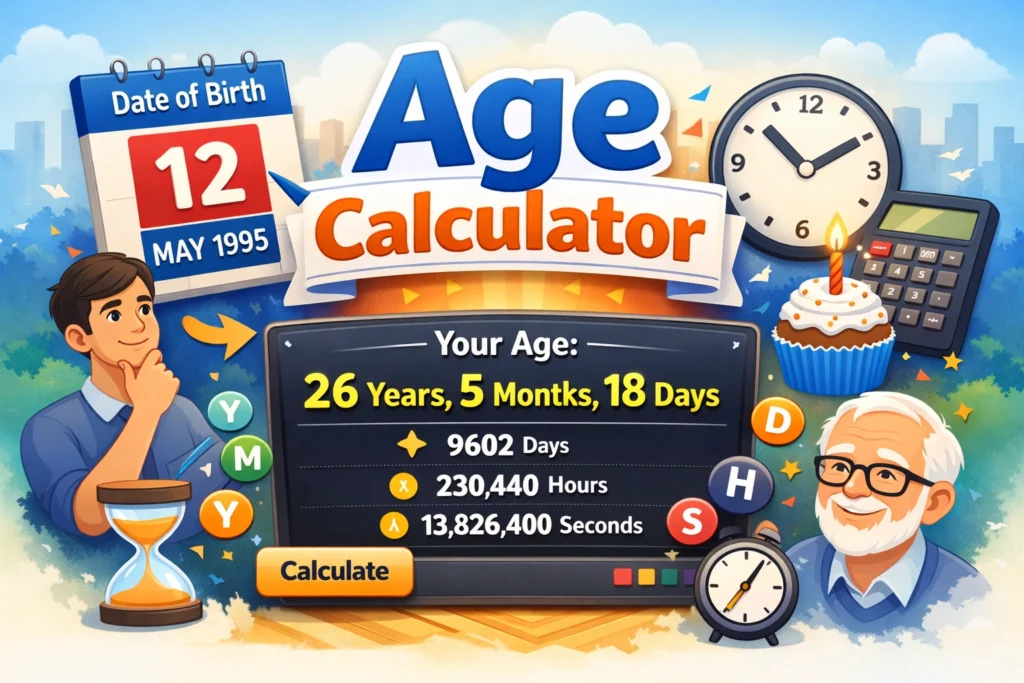
Wondering how old am I in decimal years? Instead of expressing age only as completed years, you can represent the elapsed age as a number such as 25.4 years or 41.8 years. This can be useful when you want a numerical age for calculations, comparisons, charts, or software that needs age as a single value.
A decimal age is not a replacement for the usual years-and-months age used on official documents. It is a way of expressing an elapsed interval as a single number. The exact method matters because calendar years do not all contain the same number of days.
This guide explains the difference between calendar age and decimal age, the main formulas, how leap years affect the result, worked examples, when to use 365 days versus the average Gregorian year, and common mistakes to avoid.
Quick answer: if you want an approximate decimal age based on elapsed days, divide the number of elapsed days by 365.2425. NIST notes that the Gregorian calendar has common years of 365 days and leap years of 366 days, with an average Gregorian year of 365.2425 days. For a calendar-faithful result, calculate completed years first and then express the remaining part of the current year as a fraction of the actual days in that age year.
Table of Contents
What Is Age in Decimal Years?
Decimal age expresses your elapsed age as one number instead of the familiar combination of years, months and days. If someone is 25 years, 4 months and 15 days old, a decimal representation might be approximately 25.37 years, depending on the calculation method.
The digits after the decimal point represent a fraction of a year. They do not mean “4 months and 15 days” directly. A value of 25.5 years means roughly half a year beyond 25 years, not necessarily “25 years and exactly 6 calendar months” under every calculation convention.
This distinction matters whenever the result will be used for scientific, statistical, financial, educational or software calculations. The method used to turn calendar dates into a fraction of a year should be stated when precision matters.
Quick Answer: How Old Am I in Decimal Years?
There are two useful approaches:
- Elapsed-day approximation: calculate total elapsed days and divide by 365.2425.
- Calendar-faithful approach: calculate completed years, then divide the remaining elapsed days by the number of days in the current year-long age interval.
The first method is convenient when you want one consistent average-year conversion. The second method follows the actual calendar interval more closely because it respects whether the current year-long interval contains 365 or 366 days.
Calendar Age vs. Decimal Age
Calendar age answers questions such as “How old are you?” with completed years, months and days. If your birthday has passed 25 times, your completed age is 25 years. Decimal age converts the same elapsed period into a single numerical value for calculations.
| Age format | Example | Best suited to |
|---|---|---|
| Calendar age | 25 years, 4 months, 15 days | Everyday age and official records |
| Decimal age | 25.37 years | Numerical calculations and analysis |
| Total months | 304 months plus days | Month-based comparisons |
| Total days | 9,000+ days | Exact elapsed-day calculations |
None of these formats changes the underlying date of birth. They are different ways of expressing an elapsed interval.
Decimal Age Formula
The simplest formula is:
Decimal age ≈ total elapsed days ÷ 365.2425
The value 365.2425 is the average length of a Gregorian calendar year. NIST explains that Gregorian calendar years contain either 365 or 366 days and that the average year is 365.2425 days. NIST’s time-and-frequency reference.
This formula is an approximation because it turns a varying calendar unit into a fixed average duration. It is often a convenient choice when you need one consistent conversion factor.
For example, if an elapsed interval contains 9,250 days:
9,250 ÷ 365.2425 ≈ 25.325 years
The result should be presented as approximately 25.33 years when rounded to two decimal places.
The Average-Year Method: Divide Days by 365.2425
The average-year method is especially useful when you already have a precise elapsed-day total. It avoids pretending that every calendar year has the same length while still giving you one fixed conversion factor.
- Calculate the total number of elapsed days between the birth date and target date.
- Divide the day count by 365.2425.
- Keep enough decimal places during the calculation.
- Round only the final result to the precision you actually need.
For example, 5,000 elapsed days corresponds to:
5,000 ÷ 365.2425 ≈ 13.689 years
That is a mathematical conversion of elapsed days into average Gregorian years. It should not be interpreted as saying that the person has completed exactly 13 years, 8 months and 7 days, because calendar months do not have a fixed length.
The Calendar-Faithful Method
If you want the decimal value to preserve the calendar-age structure, first determine the number of completed birthdays. Then measure the remaining portion of the current age year.
The general structure is:
Decimal age = completed years + (days since last birthday ÷ days from last birthday to next birthday)
Usually, the denominator is 365 days. If the current birthday-to-next-birthday interval crosses a leap day, it can be 366 days. This approach is closer to the way people normally understand calendar age because the fraction describes progress through the person’s current age year.
For a result intended for a particular scientific or statistical standard, use that standard’s specified age convention rather than assuming one formula is universally required.
Worked Example: Turning 25 Years, 4 Months and 15 Days into a Decimal
Suppose the calendar age is 25 years, 4 months and 15 days. The exact decimal depends on the actual dates because those months may contain different numbers of days.
For an illustration, assume the interval from the 25th birthday to the target date contains 136 elapsed days and that the birthday-to-next-birthday interval contains 365 days.
Then:
25 + (136 ÷ 365) = 25.3726 years
Rounded to two decimal places, the decimal age is 25.37 years.
The important lesson is that you should not automatically convert “4 months” to 120 days. A calendar month can have 28, 29, 30 or 31 days, so the actual dates should be used whenever accuracy matters.
How Leap Years Affect Decimal Age
Leap years add a 29 February to the calendar. That extra day affects the total elapsed-day count and can slightly change a decimal-age result.
NIST notes that a Gregorian common year has 365 days, a leap year has 366 days, and the long-term average Gregorian year is 365.2425 days. That is why dividing a date interval by 365 can produce a slightly different result from dividing it by 365.2425.
| Year basis | Days | Use in a decimal-age calculation |
|---|---|---|
| Common Gregorian year | 365 | Useful for a specific non-leap age-year interval |
| Leap Gregorian year | 366 | Useful when the specific age-year interval contains 29 February |
| Average Gregorian year | 365.2425 | Useful as a consistent long-term conversion factor |
For long intervals, using the actual elapsed days is generally preferable to simply multiplying completed years by 365 because the latter ignores leap days.
Does Birth Time Matter for Decimal Age?
For an ordinary age displayed to two decimal places, the birth time often has a very small effect. But if you want a high-precision decimal age, the birth time can matter because it changes the exact elapsed duration.
If a person was born at 6:00 PM and a calculation assumes midnight at the start of the birth date, the calculation includes an extra 18 hours. That difference is real even though both calculations use the same date of birth.
If the recorded birth time is unavailable, state that the decimal age is date-based or uses a stated assumption. The precision of the answer should not exceed the precision of the input information.
Decimal Age Reference Table
| Elapsed days | Approx. decimal years | Calculation |
|---|---|---|
| 365 | 1.00 | 365 ÷ 365.2425 |
| 730 | 2.00 | 730 ÷ 365.2425 |
| 1,000 | 2.74 | 1,000 ÷ 365.2425 |
| 3,650 | 9.99 | 3,650 ÷ 365.2425 |
| 5,000 | 13.69 | 5,000 ÷ 365.2425 |
| 7,300 | 19.99 | 7,300 ÷ 365.2425 |
| 9,250 | 25.33 | 9,250 ÷ 365.2425 |
| 10,000 | 27.38 | 10,000 ÷ 365.2425 |
These are approximate conversions from fixed day counts. They are not a substitute for calculating a person’s actual DOB-to-target-date interval.
Decimal Years vs. Total Months
If your main goal is to express age as a single number without introducing a fractional year, total months can sometimes be easier to understand. For example, 25 completed years equal 300 completed months, before counting any additional partial month.
However, months also have variable calendar lengths. There is no universal rule that one month always equals 30 days. This is why an exact age calculator should work with calendar dates rather than treating every month as a fixed duration.
Age Calculators also has a guide specifically about calculating age in total months, as well as guides for age in weeks and age in days.
When Is Decimal Age Useful?
- Data analysis: a single numeric age is convenient for spreadsheets, charts and statistical calculations.
- Scientific work: studies may need age represented as a continuous numerical variable.
- Software: applications may store or calculate age as a number rather than a text string.
- Progress tracking: decimal age can make small changes visible when comparing measurements over time.
- Personal curiosity: it provides another way to answer “how old am I?” beyond years and months.
The appropriate precision depends on the purpose. A general chart may need only one decimal place, while a research dataset may define a more precise convention in its methodology.
Common Mistakes When Calculating Decimal Age
1. Dividing by 365 Without Considering the Purpose
Dividing elapsed days by 365 is a simple approximation, but it systematically ignores leap days. If you need a long-term average-year conversion, 365.2425 is a more appropriate Gregorian average.
2. Treating Months as 30 Days
A calendar month is not a fixed 30-day unit. Converting “4 months” to “120 days” can create a noticeable error when the exact dates are known.
3. Rounding Too Early
Keep the full precision of the intermediate calculation and round only the final decimal age. Early rounding can accumulate error when the result is reused.
4. Confusing Decimal Places with Months
The number 25.5 does not universally mean exactly 25 years and 6 calendar months. It means 25.5 years under the chosen year-length convention.
5. Assuming One Formula Is Correct for Every Application
Different applications can define fractional age differently. For serious work, document whether the calculation uses elapsed days divided by 365, 365.2425, or a calendar-year fraction based on the actual birthday interval.
Decimal Age Is Not the Same as Official Age
A decimal value is a mathematical representation of elapsed age. It does not change the legal or administrative definition of age used by an authority.
For government recruitment, school admission, examinations, benefits or identity records, follow the applicable rule and its stated cutoff date. An authority may ask whether you have completed a particular number of years on a specific date, rather than asking for a decimal age.
If you need the standard calendar result first, you can use the site’s Age Calculator and then use the resulting dates to derive a decimal value under your chosen convention.
How to Get Your Decimal Age Online
An online age calculator can save time because the difficult part is determining the exact calendar interval between two dates. Once that interval is known, the conversion into a decimal number is straightforward.
- Enter your date of birth.
- Choose the target date, such as today or another specified date.
- Include your birth time if the calculator supports it and high precision is needed.
- Obtain the calendar age or elapsed-day total.
- Convert that result into decimal years using the method required for your purpose.
For a transparent result, record the DOB, target date, calculation method and rounding rule. That makes the decimal age reproducible instead of leaving the conversion method ambiguous.
Frequently Asked Questions
How do I calculate my age in decimal years?
Calculate the elapsed days between your date of birth and the target date, then divide by 365.2425 for an average Gregorian-year approximation. For a calendar-faithful result, calculate completed years and divide the remaining days by the length of the current birthday-to-birthday interval.
What does 25.5 years old mean?
It means 25.5 years under the calculation convention being used. It is a numerical representation of age, not a universal statement that exactly six calendar months have passed after the 25th birthday.
Should I divide my age by 365?
Dividing elapsed days by 365 is a simple approximation, but it ignores leap days. For an average Gregorian-year conversion, 365.2425 days is the relevant average; for calendar age, use the actual dates.
Does a leap year change my decimal age?
Yes. Leap years contain 366 days, so they affect the elapsed-day total and can slightly change the decimal result.
Can I calculate decimal age from years, months and days alone?
You can estimate it, but an exact conversion requires the underlying dates because calendar months have different lengths. Using the actual DOB and target date avoids treating every month as a fixed number of days.
Does birth time matter for decimal age?
It can matter for high-precision calculations because the birth time changes the elapsed duration. For ordinary two-decimal-place age displays, the effect is usually small, but it should not be ignored when exact timing is required.
Is decimal age accepted for government age eligibility?
Not necessarily. Official eligibility rules generally specify how age and cutoff dates are to be determined. Use the authority’s stated rule rather than substituting a decimal-age calculation.
Final Takeaway
To answer how old am I in decimal years, first decide what kind of decimal age you need. For a consistent average Gregorian-year approximation, divide elapsed days by 365.2425. For a calendar-faithful fractional age, use completed years plus the fraction of the current birthday-to-birthday interval that has elapsed.
Leap years, variable month lengths and the availability of a birth time can all affect the result. For everyday use, rounding to one or two decimal places is often enough; for formal analysis, document the calculation convention and precision.
Most importantly, decimal age is a numerical representation of an elapsed interval. It does not replace the official age or DOB rules used by institutions.
Calculation References
- NIST — Gregorian calendar year and average year length
- NIST — Standard relationships for day, hour and minute
- Wikimedia Commons — Basic Calculator Header, CC0
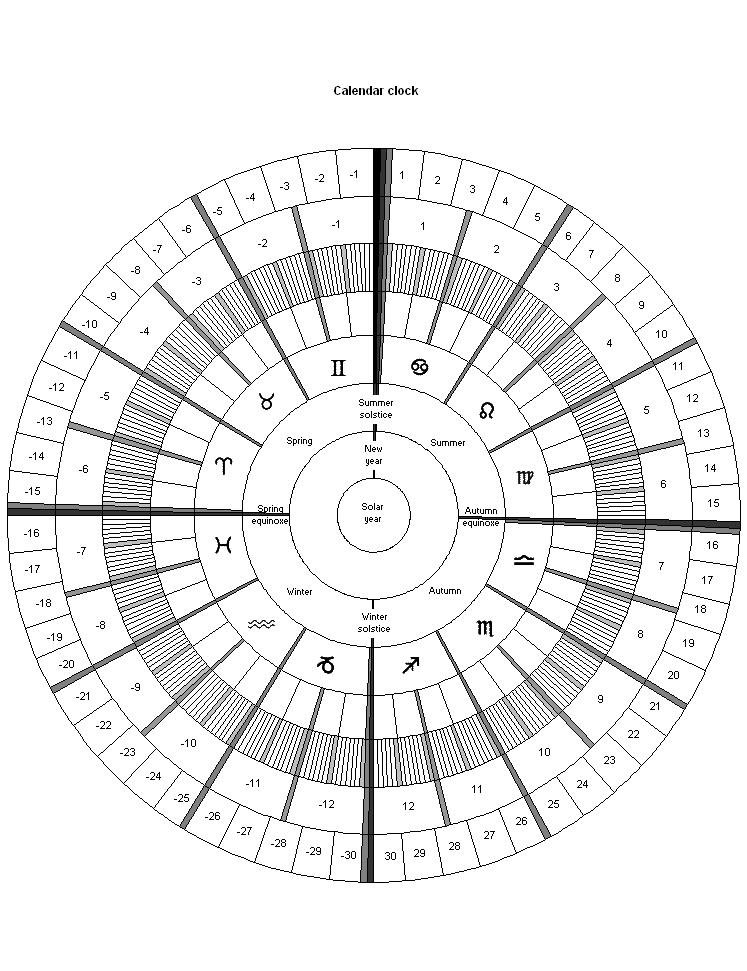
- Wikimedia Commons — Calendar clock, public domain
Calculation note: decimal-age examples are arithmetic illustrations based on the stated assumptions. Image licensing information was checked against the Wikimedia Commons source pages on 21 September 2026.