If you are checking the IGNOAPS age limit 2026, the central rule is straightforward: the Indira Gandhi National Old Age Pension Scheme (IGNOAPS), a component of the National Social Assistance Programme (NSAP), provides central assistance to eligible persons aged 60 years and above who belong to households meeting the applicable Below Poverty Line (BPL) criteria. The central contribution is ₹200 per month for ages 60–79 and ₹500 per month from age 80 onward. State and Union Territory governments may add their own top-up.
IGNOAPS Age Limit 2026 at a Glance
| Question | 2026 rule |
|---|---|
| Minimum age | 60 years |
| Age 60–79 | ₹200 per month central assistance |
| Age 80+ | ₹500 per month central assistance |
| General central upper age limit | No separate upper age cutoff stated in the IGNOAPS age rule |
| Economic condition | Household must meet the applicable BPL eligibility framework |
| Implementing level | States/UTs identify, sanction and disburse benefits under the NSAP framework |
| State top-up | States/UTs may add an amount above the central contribution |
The important point is that 60 years is the entry-age threshold, while the ₹200-to-₹500 change happens at age 80. These are two separate age milestones. Reaching 60 does not by itself guarantee an IGNOAPS pension because economic eligibility, identification and state-level implementation requirements also apply.
What Is IGNOAPS?
IGNOAPS stands for Indira Gandhi National Old Age Pension Scheme. It operates under the National Social Assistance Programme administered by the Ministry of Rural Development. NSAP provides a basic level of social assistance to vulnerable groups, with components covering old age, widowhood, disability, bereavement and food security.
For an older person, IGNOAPS is the old-age pension component. The central government provides the prescribed central assistance, while the actual identification and disbursement process is carried out through the State or Union Territory machinery. The current government material also notes that States and UTs are encouraged to provide a top-up over the central contribution.
IGNOAPS Minimum Age: 60 Years
The minimum age for IGNOAPS is 60 years. A person who has not completed 60 years does not satisfy the central old-age pension age condition. The relevant age should be established from the person’s accepted date-of-birth records and the rules used by the implementing authority.
For example, a person born on 16 September 1966 completes 60 years on 16 September 2026. A person born on 17 September 1966 is still 59 on 16 September 2026 and reaches 60 on 17 September 2026. This is why an exact DOB is more useful than simply subtracting the birth year from the current year.
Is There a Maximum Age Limit for IGNOAPS?
The central IGNOAPS age rule establishes eligibility from 60 years and above and then specifies different central assistance for ages 60–79 and 80+. The current official descriptions do not state a separate general upper age cutoff at which an otherwise eligible person’s IGNOAPS eligibility automatically ends.
Instead, age 80 is important because the central assistance increases from ₹200 to ₹500 per month. A person who remains eligible after reaching 80 therefore moves into the higher central-assistance bracket. State-level rules and verification procedures can still affect how the benefit is administered.
IGNOAPS Pension Amount: ₹200 and ₹500 Central Assistance
Under the current central framework, an eligible beneficiary aged 60 to 79 years receives ₹200 per month as central assistance. From 80 years onward, the central contribution becomes ₹500 per month.
| Beneficiary age | Central IGNOAPS assistance |
|---|---|
| Below 60 | Not eligible under the IGNOAPS old-age age condition |
| 60–79 | ₹200 per month |
| 80 and above | ₹500 per month |
The amount shown above is the central share. It should not automatically be treated as the total pension received by a beneficiary in every State or UT because states may provide additional assistance.

IGNOAPS Eligibility Rules in 2026
Age is only one part of the eligibility test. The central IGNOAPS framework is aimed at elderly persons from households that satisfy the applicable BPL criteria. The State or UT machinery is responsible for identifying eligible beneficiaries and administering the benefit.
- Age: The applicant must be 60 years or older.
- Economic eligibility: The household must fall within the applicable BPL eligibility framework used for NSAP.
- Identification: Beneficiaries are identified through the implementing State/UT system, with local bodies playing a role in the process.
- Verification: The applicant’s identity, age and other required records must be verified under the applicable procedure.
- Disbursement: Benefits are generally delivered through banking or postal channels and, under the framework, DBT is widely used.
- State rules: The State/UT can have additional administrative procedures and may provide a top-up amount.
How Age Is Calculated for IGNOAPS
For an age-based government benefit, the safest approach is to calculate completed age from the date of birth. Do not assume that everyone born in the same calendar year has already reached the age threshold on the same date.
| Date of birth | Relevant date | Completed age | IGNOAPS age position |
|---|---|---|---|
| 16 September 1966 | 16 September 2026 | 60 | Meets the age threshold |
| 17 September 1966 | 16 September 2026 | 59 | Reaches 60 the next day |
| 16 September 1946 | 16 September 2026 | 80 | Falls in the 80+ central-assistance bracket |
Documents and Verification
The exact document checklist can vary by State or UT and by the implementing department. In general, applicants should be prepared to provide records supporting identity, date of birth, residence and the bank or postal account through which the benefit is to be received, along with any documents required to establish the applicable economic eligibility.
- Accepted identity document, as required by the implementing authority.
- Date-of-birth or age proof.
- Address/residence information where required.
- Bank or post-office account details for benefit transfer.
- Documents or records required under the applicable BPL/NSAP identification process.
- Aadhaar or Aadhaar-linked information where required by the current implementation process.
Do not assume that an Aadhaar card alone proves every eligibility condition. Age, household status and other scheme requirements are separate checks.
Who Identifies and Disburses IGNOAPS Benefits?
IGNOAPS is a centrally sponsored component of NSAP, but implementation is carried out through States and Union Territories. Government material states that Gram Panchayats and municipalities play an active role in identifying eligible beneficiaries under the different NSAP components. The State/UT machinery handles sanction and disbursement according to its implementation process.
Current government material also reports extensive use of Direct Benefit Transfer. This means the beneficiary’s bank or post-office savings account can receive the benefit directly. The implementing authority remains the right place to confirm a particular applicant’s application status or pending verification.
IGNOAPS and State Top-Up Amounts
The ₹200 and ₹500 figures are the central assistance under the national framework. States and UTs are encouraged to add their own contribution. As a result, the amount actually credited to a beneficiary can be higher than the central share depending on the State or UT’s pension policy.
This distinction matters when comparing pension amounts across India. A website or local notice may quote a total monthly pension that combines the central contribution with the State contribution. For a national age-limit guide, the central IGNOAPS amounts should therefore be kept separate from state-specific top-ups.
IGNOAPS vs Other Senior-Citizen Schemes
India has several programmes for older people, and their age rules are not interchangeable. IGNOAPS is an NSAP pension component for eligible BPL households. Other programmes can use 60, 70 or other age thresholds and can have completely different eligibility tests.
For a broader explanation of the general senior-citizen age framework in India, see our Senior Citizen Age in India 2026 guide. If your question is about a bank account rather than a pension, see our Bank Account Age Limit in India guide.
How to Check or Apply for IGNOAPS
- Confirm that the applicant has completed 60 years using the accepted DOB record.
- Check whether the household satisfies the applicable BPL/NSAP eligibility conditions.
- Contact the relevant Gram Panchayat, municipality or State/UT implementing department to confirm the local process.
- Keep identity, age, residence, bank/post-office and other required documents ready.
- Complete the beneficiary identification and verification process prescribed by the implementing authority.
- After sanction, verify the bank or post-office account through which the pension is to be disbursed.
- If the beneficiary reaches 80, check that the higher central-assistance bracket has been reflected according to the implementation process.
Common IGNOAPS Age-Limit Mistakes
- Mistake 1: Treating 60 as automatic pension eligibility. Age is necessary but economic and administrative conditions also matter.
- Mistake 2: Assuming ₹200 is the total pension everywhere. It is the central contribution for ages 60–79; States/UTs may add more.
- Mistake 3: Treating 80 as an upper age limit. Age 80 marks the higher central-assistance bracket; it is not a general end point stated in the central age rule.
- Mistake 4: Calculating age only from the birth year. Use the complete date of birth when the threshold date matters.
- Mistake 5: Confusing IGNOAPS with another senior-citizen benefit. Different schemes can have different age, income and beneficiary conditions.
IGNOAPS Age Limit FAQs
What is the IGNOAPS age limit in 2026?
The central age condition starts at 60 years. Eligible beneficiaries aged 60–79 receive ₹200 per month in central assistance, while those aged 80 and above receive ₹500 per month.
Is there an upper age limit for IGNOAPS?
The central IGNOAPS descriptions specify eligibility from 60 years and above and a higher assistance bracket from 80 years. They do not state a separate general upper age cutoff.
Does everyone aged 60 qualify?
No. The person must also meet the applicable economic and beneficiary-identification conditions. Age alone does not create entitlement to the pension.
How much pension does IGNOAPS provide?
The central assistance is ₹200 per month for ages 60–79 and ₹500 per month for age 80 and above. A State or UT may provide an additional top-up.
Can a person above 80 remain an IGNOAPS beneficiary?
The central framework describes assistance for people aged 80 and above, so 80 is a higher-benefit threshold rather than a general upper age cutoff.
Where should an applicant check the application process?
The State or UT implementing authority, local body or the official NSAP system should be used to confirm the current application, identification and payment process.
IGNOAPS Beneficiary Identification and Local Bodies
Although IGNOAPS is part of a national programme, an applicant normally interacts with the local and State-level administration rather than applying directly to a central ministry office. Government material says Gram Panchayats and municipalities play an active role in identifying eligible beneficiaries under NSAP. This makes the local implementation process important when checking an application, correcting a date of birth or asking why a pension has not yet been sanctioned.
Applicants should therefore distinguish between the national eligibility rule and the local processing procedure. The national rule supplies the age and central-assistance framework, while the State or UT determines the operational route used for verification, sanction and payment.
What Happens When an IGNOAPS Beneficiary Turns 80?
Turning 80 is an important milestone under IGNOAPS because the central assistance changes from ₹200 to ₹500 per month. It is not a fresh application for an entirely different pension scheme. The beneficiary should, however, ensure that the implementing authority has the correct date-of-birth information so the higher age bracket can be reflected in the payment record.
If the beneficiary’s recorded DOB is incorrect, the person or family should approach the relevant implementing office with the accepted age-proof documents and ask how the record can be corrected. The exact correction procedure is State/UT specific, so this article does not assume one universal form or office.
IGNOAPS Payment and Direct Benefit Transfer
NSAP has increasingly used digital beneficiary records and Direct Benefit Transfer. Government material published in 2025 reported that a large majority of NSAP benefits were being delivered through DBT to bank or post-office savings accounts, with other permitted payment routes in exceptional cases. This is useful when checking whether a sanctioned pension has reached the beneficiary.
- Confirm that the beneficiary’s bank or post-office account details are correctly recorded.
- Check whether the account remains active and capable of receiving transfers.
- Keep the beneficiary’s name and DOB consistent across the records used for verification.
- If a payment is missing, contact the local or State/UT implementing authority rather than assuming the national age rule has changed.
IGNOAPS Age Limit: 60 vs 80 Explained
| Age milestone | Meaning under IGNOAPS |
|---|---|
| Before 60 | The person has not reached the central old-age pension age threshold. |
| Exactly 60 | The person reaches the minimum age condition, subject to the other eligibility tests. |
| 60–79 | ₹200 per month central assistance for an eligible beneficiary. |
| Exactly 80 | The beneficiary reaches the higher central-assistance age bracket. |
| 80+ | ₹500 per month central assistance for an eligible beneficiary. |
This simple distinction prevents two common errors: saying that IGNOAPS starts only at 80, or saying that benefits stop at 80. Neither describes the central age structure. The programme starts at 60, and age 80 changes the central contribution.
IGNOAPS Checklist for Families
- Write down the beneficiary’s complete date of birth.
- Calculate the completed age on the date relevant to the application or age-band change.
- Confirm that the household meets the applicable BPL/NSAP condition.
- Keep identity and age documents available for verification.
- Confirm the bank or post-office account used for payment.
- Ask the local implementing authority about the State/UT application process.
- If the beneficiary has reached 80, verify that the age record supports the higher central-assistance bracket.
- Keep copies or acknowledgements of applications and corrections where the local process provides them.
Current IGNOAPS Scale and NSAP Context
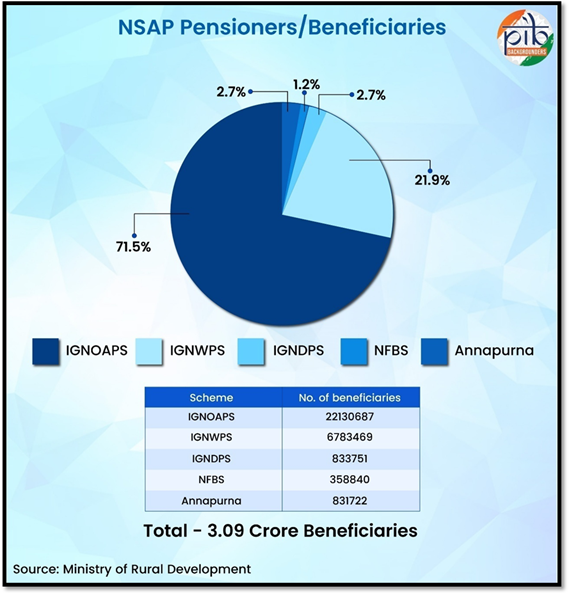
Government information published in 2025 reported more than 2.21 crore IGNOAPS beneficiaries as part of the wider NSAP network, which had about 3.09 crore beneficiaries across its five components. A later PIB update in August 2026 continued to describe NSAP as covering elderly persons, widows, persons with disabilities and bereaved households, with scheme-wise beneficiary ceilings for States and UTs.
The 2025–26 NSAP budget allocation reported by the government was ₹9,652 crore across the programme’s components, including ₹6,645.90 crore for IGNOAPS. These programme-level figures can change with budget cycles and implementation updates, so they should not be confused with the individual pension amount.
Official IGNOAPS and NSAP Sources
- National Social Assistance Programme official portal
- myScheme — IGNOAPS scheme information
- PIB — Implementation of NSAP, 4 August 2026
- PIB — Elderly Schemes and Beneficiaries, 11 February 2026
- PIB — Social Security for Senior Citizens, 1 April 2026
Final Takeaway
The IGNOAPS age limit 2026 starts at 60 years. For eligible beneficiaries, the central assistance is ₹200 per month from 60 to 79 and ₹500 per month from 80 onward. The central framework does not state a separate general maximum age. However, age is only one eligibility test: the applicable BPL/economic conditions, beneficiary identification, document verification and State/UT implementation process also matter.