
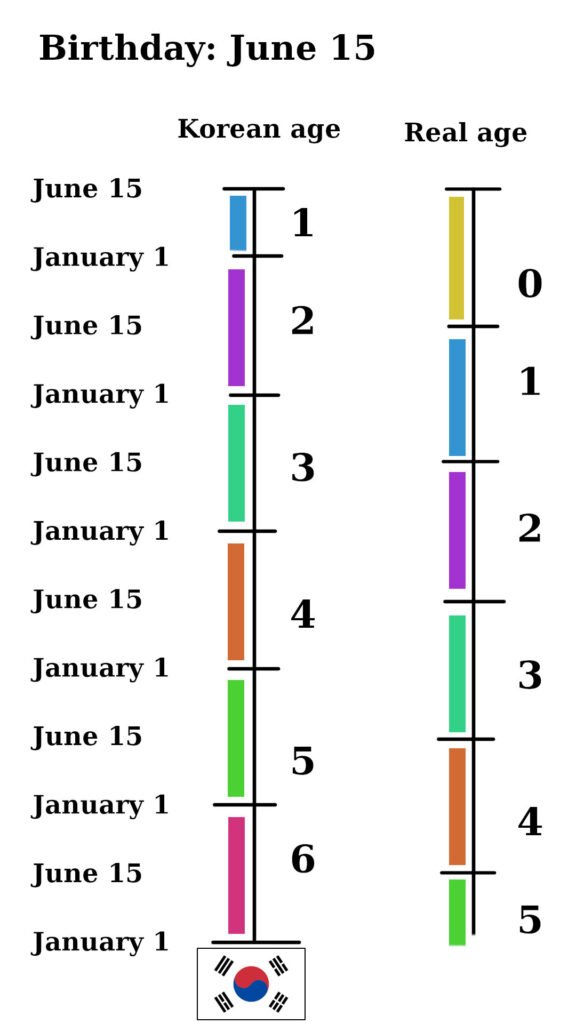
A Korean age calculator can look straightforward until you see two different numbers for the same person. The reason is that “Korean age” traditionally counted age differently from the international system used for a person’s completed years. The difference can be one year or, around the start of a calendar year, two years.
For readers trying to understand Korean dramas, older articles, family conversations, or an age shown by a calculator, the key is to identify which age system is being used. For current legal and administrative purposes in South Korea, international age (만 나이) is the general rule under the 2023 changes to the Civil Act and Framework Act on Administration, except where another law provides a different rule. The Ministry of Government Legislation explains the rule and its exceptions on its official “만 나이 통일” page.
This guide shows how to calculate the traditional Korean counting age, how to calculate international age on an exact date, why the result can differ by one or two years, and how to read Korean age references correctly in 2026.
Korean Age Calculator: Quick Answer
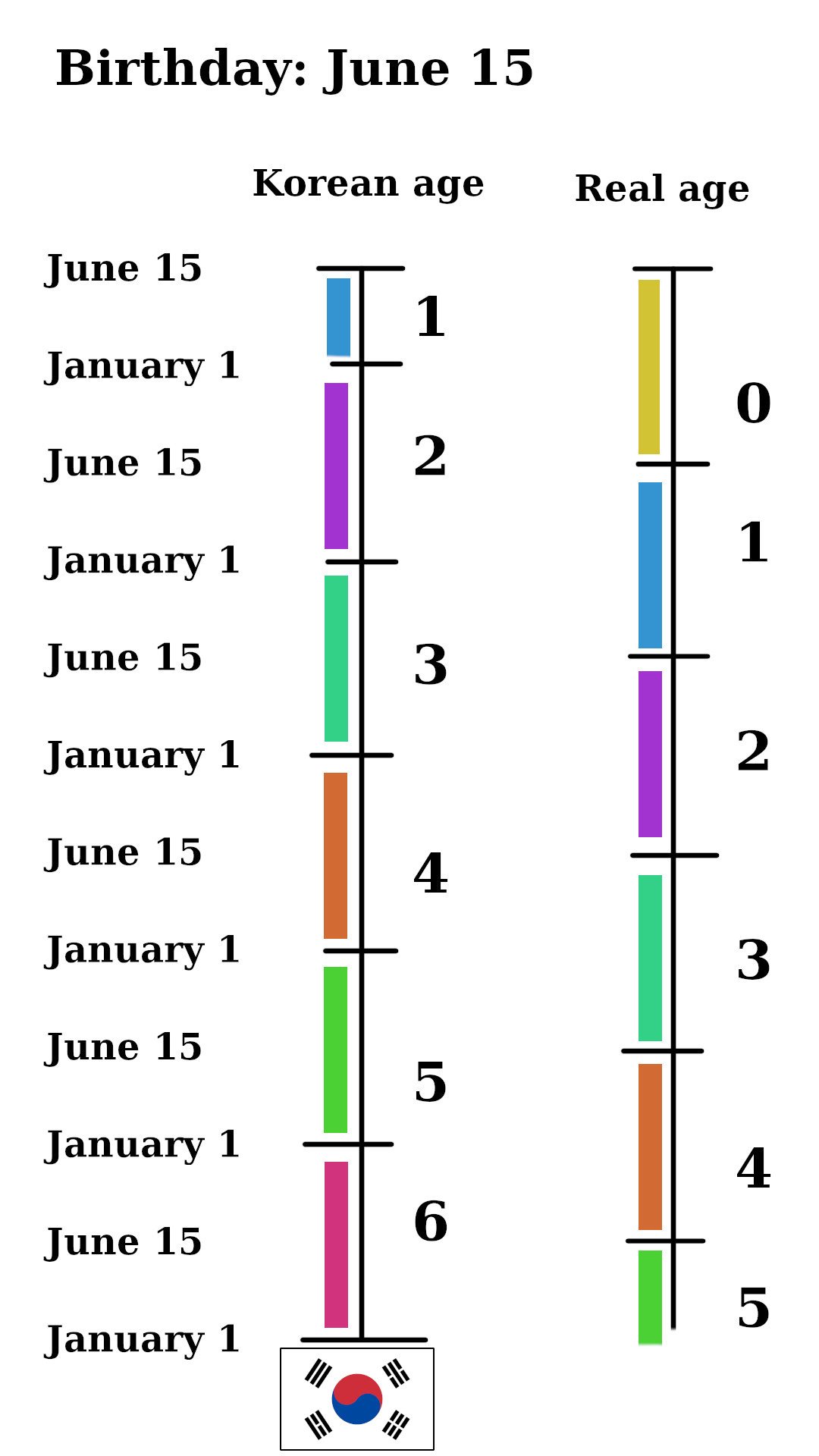
The traditional Korean counting-age formula is reference year − birth year + 1. A baby is counted as 1 at birth, and everyone reaches the next counting-age number together on January 1. By contrast, international age starts at 0 on the date of birth and increases by one on each birthday.
| Age system | Starting point | When age increases | Simple calculation | How to interpret it in 2026 |
|---|---|---|---|---|
| International age (만 나이) | 0 at birth | On the birthday | Reference year − birth year, then subtract 1 if the birthday has not happened yet | General legal/administrative rule unless a specific rule says otherwise |
| Traditional Korean counting age (세는 나이) | 1 at birth | Every January 1 | Reference year − birth year + 1 | Useful for understanding traditional or older Korean age references |
| Year age (연 나이) | 0 in the birth year calculation | Changes with the calendar year | Reference year − birth year | Used only where a specific rule adopts a year-based age method |
So, a Korean age calculator is best understood as a conversion tool: enter the date of birth, choose the date you are checking, and then read the result for the requested age system.
What Is Korean Age?
“Korean age” usually refers to the traditional 세는 나이 system. Its defining feature is that the person is considered one year old at birth. The next increase happens on January 1 rather than on the person’s individual birthday.
That means two people born in the same calendar year have the same traditional counting age on the same date. The month and day of birth do not change the traditional formula. They do matter for international age, because international age follows each person’s birthday.
The traditional system is especially useful when you are interpreting an older Korean article, a translated television show, a family conversation, or another source that uses the phrase “Korean age” in its traditional sense. It is not the same thing as the current general legal and administrative standard.
How a Korean Age Calculator Works
A useful calculator should make the reference date clear. “How old am I in 2026?” is not always enough for an exact international-age answer, because your birthday may be later in the year. A precise calculator therefore works from a full birth date and a specific reference date.
- Enter the complete date of birth, including day, month, and year.
- Choose the date on which you want the age calculated. You can use today, a past date, or a future date.
- Calculate international age by checking whether the birthday has already occurred in the reference year.
- Calculate traditional Korean counting age from the two years using the +1 formula.
- Compare the two results rather than treating one number as a correction of the other. They are outputs from different counting rules.
For a quick international calculation from date of birth, you can also use the site’s Age Calculator. For a future reference date, the existing future-age guide explains why the exact target date matters.
One practical way to avoid confusion is to write both numbers side by side. For example, a person can have a traditional Korean counting age of 27 and an international age of 25 on the same reference date. The two figures are not competing calculations of the same rule; they are answers produced by different age systems. When you see a number in a Korean source, look for terms such as 만 나이, 세는 나이, or a reference to a year-based rule. That small check can prevent mistakes when translating ages, comparing biographies, or reading older Korean content.
Traditional Korean Age Formula
The traditional formula is intentionally simple:
Traditional Korean age = Reference year − Birth year + 1
Suppose a person was born in 2000 and the reference year is 2026. The traditional calculation is 2026 − 2000 + 1 = 27. The person’s birth month and day do not change this traditional counting-age number.
This is also why a child born on December 31 can move from counting age 1 to counting age 2 on the very next day, January 1. The calendar year changes, so the traditional counting age changes for everyone at once.
Example: Born June 15, 2000
On September 21, 2026, the traditional Korean counting age is 27, because 2026 − 2000 + 1 = 27.
Example: Born December 15, 2000
On September 21, 2026, the traditional Korean counting age is still 27. The exact birthday date does not affect the traditional formula.
International Age Formula
International age is the completed number of years since the date of birth. The calculation begins at 0 on the birth date and increases by one on each birthday.
A simple year-based starting point is reference year − birth year. Then ask one question: Has the birthday happened yet in the reference year? If not, subtract one.
For example, a person born on June 15, 2000 is 26 on September 21, 2026 because the June 15 birthday has already happened. A person born on December 15, 2000 is 25 on the same reference date because the December 15 birthday is still ahead.
This is the same basic idea used by an exact age calculator, although an exact calculator can also express the result in years, months, and days. The site’s age calculator by date of birth guide covers that broader calculation.
Why Korean Age Can Be 1 or 2 Years Higher
The gap is created by two separate rules: traditional counting age starts at 1, while international age starts at 0 and waits for the birthday before adding the next completed year.
| Birth date | Reference date | Traditional Korean age | International age | Difference |
|---|---|---|---|---|
| June 15, 2000 | September 21, 2026 | 27 | 26 | +1 |
| December 15, 2000 | September 21, 2026 | 27 | 25 | +2 |
| December 31, 2000 | January 1, 2001 | 2 | 0 | +2 |
The second row is the common reason a person can appear two years older under the traditional calculation. The year has already changed, so counting age has increased, but the person has not yet reached their next birthday, so international age has not increased.
Korean Age vs International Age in 2026
The table below is a quick 2026 reference. For international age, the number depends on whether the birthday has already occurred in 2026. The traditional counting-age number depends only on the birth year.
| Birth year | Traditional Korean age in 2026 | International age before birthday | International age after birthday |
|---|---|---|---|
| 2026 | 1 | 0 | 1 after the first birthday |
| 2010 | 17 | 15 | 16 |
| 2000 | 27 | 25 | 26 |
| 1995 | 32 | 30 | 31 |
| 1990 | 37 | 35 | 36 |
| 1980 | 47 | 45 | 46 |
| 1970 | 57 | 55 | 56 |
For a person born during the current year, the international-age result is 0 until the first birthday is reached. That is another reminder that a birth year alone cannot answer every age question exactly.
What Changed in South Korea in 2023?
South Korea introduced changes to make 만 나이, or completed international age, the general age-counting standard for administrative and civil matters. The amendments to the Framework Act on Administration and Civil Act took effect on June 28, 2023.
The Ministry of Government Legislation states that, unless another law or regulation provides a special rule, administrative age should be calculated as full age based on the date of birth. Its official guidance also explains that some areas can remain exceptions where a separate statute specifies a different age-counting method.
The National Law Information Center records the Civil Act amendment effective June 28, 2023. You can review the official legislation at Korea’s National Law Information Center.
The practical lesson is simple: do not assume the traditional Korean counting age is still the number an official form is asking for. Read the wording of the current rule and use the age standard specified by the relevant institution or law.
Is Traditional Korean Age Still Useful?
Yes, but its role is different from its former legal prominence. A traditional Korean age calculator can still be useful as a cultural and interpretive tool. It helps when a source uses 세는 나이, when an older publication was written before the 2023 change, or when someone is comparing the traditional system with the international system.
The Ministry of Justice explained during the reform process that several age-counting systems had coexisted, including international age, a year-based counting method, and traditional Korean age. That background helps explain why older Korean content can contain numbers that look “off” when compared with a modern international-age calculator.
So the phrase “Korean age” needs context. It can describe the traditional counting system in a cultural explanation, while a current official process may be using 만 나이 instead.
How to Calculate Korean Age Without a Calculator
You only need the birth year and the reference year for the traditional counting-age formula. For international age, you need the complete birthday.
Traditional counting age
- Take the reference year. For this guide, use 2026.
- Subtract the birth year.
- Add 1.
- The result is the traditional Korean counting age for that year.
Example: a 1995 birth year gives 2026 − 1995 + 1 = 32 traditional counting years.
International age
- Subtract the birth year from the reference year.
- Check whether the birthday has already occurred in that year.
- If the birthday has not occurred, subtract 1.
- The remaining number is the completed international age in years.
Example: someone born on October 20, 1995 is 30 on September 21, 2026 and becomes 31 on October 20, 2026.
Why the Exact Date Matters
Traditional Korean age can be calculated from years alone, but international age cannot always be. A person born on December 31, for example, can have a different international age on January 1 than on December 31 of the same year.
The exact-date issue matters even more when an age is being checked against an eligibility cutoff, a form requirement, or a milestone. In those cases, the question is not simply “What is my age?” but “What is my age on this date?”
That is why a date-of-birth calculator and a future-age calculator are useful companions to a Korean age conversion. They let you keep the reference date explicit instead of making assumptions from the year alone.
Common Korean Age Calculation Mistakes
- Using the traditional +1 formula when the source is asking for international age.
- Subtracting birth year from reference year without checking whether the birthday has happened.
- Assuming that every Korean law, form, or institution uses the same age system.
- Confusing traditional counting age with year age. The formulas are different.
- Quoting a Korean age number from an older article without checking which counting system it used.
- Giving an exact legal-eligibility answer from a general calculator without reading the current rule that defines the cutoff.
Which Age Should You Use for Official Purposes?
For a current South Korean administrative or civil question, the 2023 framework makes 만 나이 the general default unless another applicable rule specifies a different method. That does not mean every age-based rule across every subject area can be reduced to one formula. The official guidance explicitly keeps room for special rules.
For that reason, use the calculator as a way to calculate the stated age standard, not as a substitute for the rule itself. If a government form, school, employer, visa process, medical institution, or other organization provides a definition or cutoff date, follow that wording.
For an India-focused legal-age reference, the site also has a separate guide on age of majority in India. It is separate from Korean age calculation, but it can be useful when comparing how jurisdictions define age and adulthood.

Understanding Korean Age in Older Media and Conversations
If you encounter a Korean age number in older media, the first useful question is not “Which number is wrong?” but “Which system is being used?” Traditional counting age can be higher than international age because of the birth-year + New Year method. That can produce a one- or two-year difference without either number being a mathematical mistake.
The context can also contain clues. A discussion about everyday self-introduction may be using a traditional or informal convention, while an official document is more likely to state the age standard or use the current legal default. Older sources should be read with the date of publication in mind because the 2023 reform changed the general legal and administrative framework.
Korean Age Calculator FAQ
What is the Korean age formula?
For traditional Korean counting age, use reference year − birth year + 1. The person starts at 1 at birth and everyone gains a year on January 1.
Is Korean age the same as international age?
No. Traditional Korean counting age and international age use different rules. International age starts at 0 at birth and increases on each birthday, so the two numbers can differ by one or two years.
What is my Korean age in 2026?
Use your birth year in the traditional formula: 2026 − birth year + 1. For your exact international age in 2026, you also need your birth month and day so you can check whether your birthday has passed.
Does South Korea still use Korean age officially?
Since June 28, 2023, international full age (만 나이) is the general standard in administrative and civil matters unless a particular law provides a different rule. Traditional Korean counting age remains useful for understanding cultural or older references.
Why can Korean age be two years older?
Traditional counting age adds one at birth and another year for the January 1 change. If the calendar year has changed but the person’s birthday has not happened yet, the traditional number can be two higher than international completed age.
Can a Korean age calculator calculate age on a specific date?
Yes. A calculator can compare your birth date with a chosen reference date. For international age, that date determines whether the birthday has already occurred. For traditional Korean counting age, the reference year is the key input.
Should I use Korean age for a legal or government form?
Use the age standard stated by the current rule or form. In South Korea, international full age is the general legal and administrative standard after the 2023 changes, but specific laws can contain exceptions.
Sources and Further Reading
- Ministry of Government Legislation — 만 나이 통일 (official guidance on the international-age standard and exceptions).
- Ministry of Government Legislation — what changed and what did not under the 2023 “full age” reform.
- National Law Information Center — Civil Act (official legislation record).
- Korea.net — Changes in 2023 affecting expats and foreign nationals (official Republic of Korea website).
The legal notes above describe the general framework published by Korean authorities. For a real-world transaction or eligibility decision, check the current rule issued by the responsible authority because individual laws can contain exceptions.
Conclusion
A Korean age calculator is most useful when it makes the age system visible. Traditional Korean counting age starts at 1 and increases for everyone on January 1, while international age starts at 0 and increases on the birthday. That difference explains why the traditional number can be one or two years higher.
For 2026, the traditional formula remains easy to calculate from birth year alone: 2026 − birth year + 1. Exact international age needs the complete date of birth and a reference date. Since June 28, 2023, international full age is the general standard for Korean administrative and civil matters unless a specific rule says otherwise.
When you are checking an age for a form, application, eligibility rule, or other official purpose, use the age definition in the current rule rather than assuming that the traditional “Korean age” number is the required one.


