
If you are searching for the Annapurna Scheme age limit 2026, the key point is that current government material describes the scheme for BPL senior citizens who are eligible for the old-age pension but are not receiving it. Because current NSAP material defines the old-age pension route from age 60, the practical age reference for Annapurna in 2026 is 60 years and above, subject to the other eligibility conditions. The benefit is 10 kg of food grains per month free of cost.
Annapurna Scheme Age Limit 2026: Quick Answer
| Rule | Current position |
|---|---|
| Age reference | 60 years and above through the current old-age pension eligibility framework |
| Household status | BPL, subject to the applicable NSAP identification rules |
| Pension condition | Eligible for old-age pension but not receiving it |
| Benefit | 10 kg food grains per month, free of cost |
| Nature of scheme | Food-security assistance, not a monthly cash pension |
| Implementation | States and Union Territories under the NSAP framework |
The most important distinction is that Annapurna is not simply a benefit available to every person who turns 60. The beneficiary must also fall within the relevant BPL and old-age-pension eligibility framework and must not be receiving the old-age pension. Current government descriptions continue to list Annapurna as one of the five NSAP components.
What Is the Annapurna Scheme?
The Annapurna Scheme is a food-security component of the National Social Assistance Programme (NSAP), administered by the Ministry of Rural Development. NSAP currently comprises five components: the Indira Gandhi National Old Age Pension Scheme (IGNOAPS), Indira Gandhi National Widow Pension Scheme (IGNWPS), Indira Gandhi National Disability Pension Scheme (IGNDPS), National Family Benefit Scheme (NFBS), and Annapurna.
The purpose of Annapurna is different from a pension. Government material describes it as providing food grains to senior citizens who are otherwise eligible under the old-age pension scheme but are not receiving that pension. The current benefit is 10 kg of food grains every month. The scheme is therefore especially relevant when a person meets the underlying old-age assistance criteria but remains uncovered by the pension benefit.
Annapurna Age Limit 2026 Explained
Current NSAP material says old-age pension assistance is available to eligible BPL senior citizens aged 60 years and above. The Annapurna Scheme is described for senior citizens who are eligible for that old-age pension but are not receiving it. For that reason, 60 years is the relevant current age starting point when checking Annapurna eligibility in 2026.
Does age 60 qualify?
Age 60 is within the current old-age pension age framework. However, reaching 60 by itself does not automatically create an Annapurna entitlement. The person must also satisfy the BPL and other applicable conditions and must be eligible for the old-age pension while not actually receiving that pension.
Is there a separate maximum age limit?
Current government descriptions do not state a separate maximum age for Annapurna. The scheme is linked to senior citizens who meet the old-age pension eligibility framework and are not receiving that pension. Therefore, the key age check is whether the person has reached the relevant senior-citizen/old-age-pension threshold, rather than a separate upper-age cutoff.
Why do some older pages mention age 65?
Older government material from the period when the old-age pension scheme used a 65-year threshold described Annapurna for indigent senior citizens aged 65 or above. That historical wording should not be treated as the current 2026 age rule. Current NSAP material uses 60 years and above for the old-age pension component, and current Annapurna descriptions link eligibility to people who are otherwise eligible for that pension but are not receiving it.
Who Is Eligible for Annapurna in 2026?
Annapurna eligibility involves more than age. The current central description identifies the target group as BPL senior citizens who are eligible for the old-age pension but are not receiving that pension. In practice, the State or local implementing authority verifies the household and beneficiary records.
- The applicant should be a senior citizen covered by the applicable old-age pension eligibility framework.
- The applicant’s household should satisfy the relevant BPL identification conditions.
- The person should be eligible for old-age pension assistance but should not be receiving that pension.
- The beneficiary must be identified and verified through the applicable State/UT and local administration.
- Any additional documentation or procedural requirements prescribed by the implementing authority must be met.
This means that age 60+ is necessary context, but it is not sufficient on its own. A senior citizen receiving the old-age pension would not normally fall into the Annapurna target group because the scheme is intended for eligible people who remain outside the pension benefit.

What Benefit Does Annapurna Provide?
The central benefit is 10 kg of food grains per person per month, free of cost. This is different from the monthly cash assistance provided under IGNOAPS, where the current central share is ₹200 per month for ages 60–79 and ₹500 per month from age 80, subject to the pension scheme’s eligibility conditions.
For someone researching the age rule, this distinction is important: Annapurna is not a pension payment. It is a food-grain entitlement intended to provide food security to a particular group of senior citizens who are eligible for old-age pension but are not receiving it.
Annapurna vs IGNOAPS: Do Not Mix the Rules
| Feature | Annapurna | IGNOAPS |
|---|---|---|
| Target group | BPL senior citizens eligible for old-age pension but not receiving it | Eligible BPL senior citizens receiving old-age pension assistance |
| Age reference | Linked to current old-age pension eligibility, 60+ | 60 years and above |
| Central benefit | 10 kg food grains per month | ₹200/month at 60–79; ₹500/month at 80+ |
| Benefit type | Food grains | Cash pension |
| Scheme family | NSAP | NSAP |
If you are comparing the two schemes, our IGNOAPS age limit 2026 guide explains the separate pension age and payment rules. You can also read our Senior Citizen Age in India 2026 guide for the broader meaning of age 60 and age 80 in Indian government and financial contexts.
Annapurna Age Calculation: DOB Examples
For age-sensitive welfare applications, use the full date of birth rather than only the birth year. The implementing authority may verify the beneficiary’s DOB against official records. The following examples illustrate the current age framework without replacing the State/UT verification process.
| Example | Age | Age-rule position |
|---|---|---|
| Example 1 | 59 years 11 months | Below the 60+ old-age-pension threshold |
| Example 2 | 60 years exactly | Within the current old-age-pension age framework; other conditions still apply |
| Example 3 | 67 years | Within the senior-citizen age framework |
| Example 4 | 79 years | Within the old-age pension framework |
| Example 5 | 80 years | Still within the senior-citizen framework; the separate IGNOAPS rate changes at 80 |
A person should not assume that turning 60 automatically switches them into Annapurna. The authority must first determine whether the household and beneficiary meet the applicable old-age-pension and BPL conditions and whether the person is actually receiving the pension.
Documents to Keep Ready
The exact document list can differ between States, Union Territories and local implementing offices. For an Annapurna-related verification, applicants should generally be prepared to establish identity, age, household status and the fact that the old-age pension is not being received.
- Date-of-birth or age proof.
- Identity and address proof.
- BPL or household eligibility record, where applicable.
- Details of the bank/post-office account or other payment records if requested by the local authority.
- Old-age pension status or records showing that pension is not being received, where applicable.
- Aadhaar or other identification details where required under the local process.
- Any State/UT form, declaration or additional verification document requested by the implementing authority.
How to Check or Apply for Annapurna in 2026
NSAP is implemented through States and Union Territories, so there is not necessarily one identical application route throughout India. Depending on the location, the process may involve a Gram Panchayat, Municipality, Social Welfare Department, Rural Development office, designated State portal or another notified authority.
- Confirm the beneficiary’s complete date of birth and current age.
- Check whether the household falls within the applicable BPL/NSAP identification framework.
- Confirm that the person is eligible for old-age pension but is not receiving that pension.
- Collect identity, DOB, household and pension-status documents.
- Contact the designated State/UT or local NSAP implementing authority.
- Submit the required application, declaration or verification documents.
- Keep the acknowledgement or application reference number if one is issued.
- Follow up through the official State/UT process if additional verification is requested.
Is Annapurna Still Active in 2026?
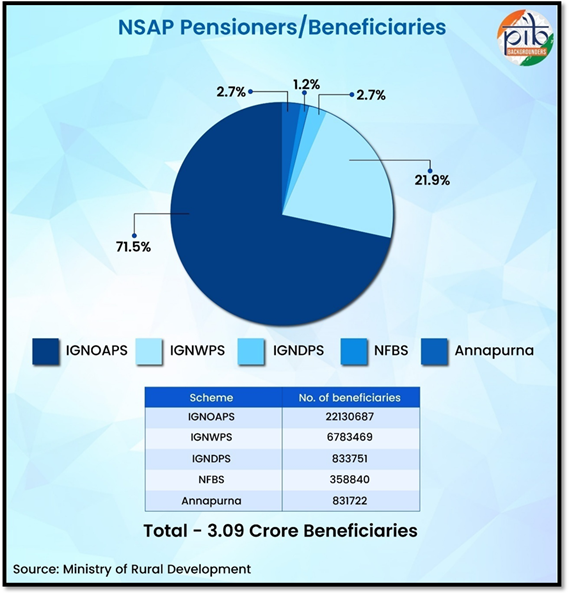
Yes. Current government material continues to list Annapurna as one of the five NSAP components. A Ministry of Rural Development release dated 4 August 2026 states that Annapurna provides food grains to senior citizens who are eligible for old-age pension but are not receiving it. The same release says NSAP caters to 3.09 crore beneficiaries overall, with scheme-wise ceilings for States and Union Territories.
A government NSAP backgrounder published in November 2025 reported 8.31 lakh Annapurna beneficiaries across the country and described the benefit as 10 kg of food grains per month for senior citizens who are eligible for the old-age pension but do not receive it. The figures are programme-level implementation data and do not change the underlying eligibility rule.
Why the Old Age Pension Connection Matters
The phrase “eligible for old-age pension but not receiving it” is central to understanding Annapurna. It means the scheme should not be read as a completely separate age-based food scheme with an independent 60-to-some-upper-age range. Instead, it is a safety-net component within NSAP for a group of senior citizens who otherwise meet the old-age assistance framework but remain outside the pension benefit.
This also explains why historical pages can be confusing. The old-age pension age criteria have changed over time, and older Annapurna descriptions referred to the then-current 65-year threshold. Current official material uses 60+ for the old-age pension component. For a 2026 eligibility check, current NSAP information should take precedence over an old article quoting an earlier age threshold.
Common Annapurna Age-Limit Mistakes
- Mistake 1: Using the old 65-year rule. Historical material used a 65-year old-age threshold, but current NSAP old-age pension guidance uses 60+.
- Mistake 2: Assuming everyone aged 60+ gets Annapurna. BPL status and the old-age-pension-not-received condition also matter.
- Mistake 3: Treating Annapurna as a cash pension. The central benefit is 10 kg of food grains per month.
- Mistake 4: Ignoring pension status. Annapurna is intended for eligible senior citizens who are not receiving the old-age pension.
- Mistake 5: Assuming one national application process. State/UT and local implementation can differ.
- Mistake 6: Checking only the birth year. Use the complete DOB for borderline age cases.
Frequently Asked Questions
What is the Annapurna Scheme age limit in 2026?
The current practical age reference is 60 years and above, because Annapurna is for BPL senior citizens who are eligible under the current old-age pension framework but are not receiving that pension.
How much food grain is given under Annapurna?
The central scheme description provides 10 kg of food grains per person per month free of cost.
Is Annapurna a monthly pension?
No. Annapurna provides food grains. It is separate from IGNOAPS, which provides central cash pension assistance to eligible BPL senior citizens.
Can a person aged 60 apply for Annapurna?
Age 60 falls within the current old-age-pension age framework, but the person must also satisfy the BPL and other applicable conditions and must be eligible for old-age pension without receiving it. The local implementing authority makes the relevant verification.
Does Annapurna have a maximum age?
Current government descriptions do not state a separate maximum age for Annapurna. Eligibility is linked to the senior-citizen old-age-pension framework and the condition that the eligible person is not receiving that pension.
Why do some websites say the age is 65?
That wording comes from older versions of the government framework, when the old-age pension eligibility threshold was 65. Current NSAP material uses 60 years and above for the old-age pension component, so 60+ is the relevant current reference for a 2026 check.
Where can I check official Annapurna information?
Use the official NSAP portal and current Ministry of Rural Development/PIB releases. The August 2026 NSAP implementation release confirms that Annapurna remains one of the five NSAP components and provides food grains to eligible senior citizens who are not receiving old-age pension.
Annapurna Eligibility Checklist for 2026
- Check that the beneficiary is at least 60 under the current old-age pension framework.
- Confirm the applicable BPL/NSAP household status.
- Confirm that the beneficiary is eligible for old-age pension.
- Confirm that the beneficiary is not receiving the old-age pension.
- Keep complete DOB and identity records available.
- Check the State/UT’s current local implementation route.
- Submit the required verification and household documents.
- Retain the application acknowledgement or reference number.
What Happens If the Pension Is Later Approved?
Annapurna is intended as a safety-net option for eligible senior citizens who are not receiving the old-age pension. If a beneficiary’s circumstances change and an old-age pension is subsequently sanctioned, the household should follow the instructions of the implementing authority because the two benefits are designed for different coverage situations. The food-grain benefit should not be treated as a substitute for checking whether the beneficiary is entitled to the pension itself.
This is also why applicants should keep their pension-status information current. A record may show that a person is eligible for old-age pension even when payment has not started, has been interrupted, or is being processed. The local authority may need to determine the precise status before deciding which NSAP support route applies.
State and Local Implementation Can Matter
The central Government establishes the NSAP framework, but States and Union Territories are responsible for implementation and local delivery arrangements. This can affect where an applicant submits documents, which records are checked first, how beneficiary identification is completed, and how food grains are distributed. A person should therefore use the current local instructions instead of relying on an old application form or a process described for another State.
NSAP also operates with scheme-wise beneficiary ceilings for States and Union Territories. Government releases explain that assistance is sanctioned within the applicable digitised-beneficiary and State/UT ceiling framework. These administrative limits are separate from the age test. In other words, a beneficiary should not interpret a State-level ceiling or processing delay as a change to the national age reference.
Final 2026 Check Before Applying
Before approaching the implementing office, check the case in this order: first confirm the full DOB and that the person is within the current 60+ senior-citizen framework; next confirm the household’s applicable BPL status; then confirm that the person is eligible for old-age pension but is not receiving it. After those checks, gather the identity, age, household and pension-status records requested locally. This sequence helps avoid treating age as the only eligibility condition.
If a local official uses an older age threshold or a different programme name, ask for the current scheme or notification being applied. Annapurna is one component of NSAP, while States may also operate their own welfare schemes. Keeping the central NSAP rule separate from State-level benefits makes it easier to identify the correct entitlement.
Official Sources
- National Social Assistance Programme (NSAP) official portal
- PIB: Implementation of NSAP, 4 August 2026
- PIB: National Social Assistance Programme backgrounder, 7 November 2025
- PIB: Department of Rural Development Year Ender 2025
- PIB: Historical Annapurna Scheme food-grain description
Bottom line: For 2026, the relevant Annapurna age reference is 60 years and above because the scheme is for BPL senior citizens who are eligible for the current old-age pension but are not receiving it. The central benefit is 10 kg of food grains per month free of cost. The old 65-year reference found in historical material reflects an earlier eligibility framework and should not be used as the current 2026 age rule.


