If you are searching for the National Family Benefit Scheme age limit 2026, the key rule concerns the age of the deceased primary breadwinner. Under the current National Social Assistance Programme (NSAP) framework, NFBS provides a one-time ₹20,000 assistance to an eligible BPL household when its primary breadwinner dies and the deceased was 18 to 59 years old. The scheme is administered through States and Union Territories, so the application and verification process can vary by location.
National Family Benefit Scheme Age Limit 2026: Quick Answer
| Rule | Current NFBS position |
|---|---|
| Age of deceased primary breadwinner | 18 to 59 years |
| Household condition | Below Poverty Line (BPL), subject to the applicable identification rules |
| Assistance | ₹20,000 one-time support |
| Nature of benefit | Lump-sum family assistance, not a monthly pension |
| Implementation | States and Union Territories under NSAP |
| Application | Through the applicable State/UT/local welfare administration |
The most important point is that 18–59 years describes the deceased breadwinner, not a universal age limit for the surviving applicant. The surviving family member must satisfy the scheme’s household and other applicable conditions. This distinction matters because a search for “NFBS age limit” can otherwise produce the wrong impression that the claimant must personally be between 18 and 59.
What Is the National Family Benefit Scheme?
The National Family Benefit Scheme (NFBS) is one of the five components of the National Social Assistance Programme (NSAP) implemented by the Ministry of Rural Development. NSAP covers old-age assistance, widow assistance, disability assistance, family benefit and the Annapurna food-security component. NFBS addresses a different situation from the pension schemes: it provides a one-time payment when a BPL household loses its primary breadwinner.
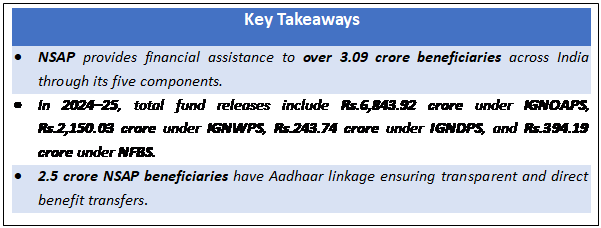
The Government’s current NSAP material continues to list NFBS as a component of the programme. A July 2026 Ministry of Rural Development update also reports that NFBS funds are released to States and UTs against proposals and beneficiary ceilings. For 2026–27, the Ministry issued a first-instalment Mother Sanction of ₹369.25 crore under the SNA-SPARSH mechanism for States/UTs that had completed the relevant onboarding process.
NFBS Age Limit 2026 Explained
The current central rule is simple: the primary breadwinner who died must have been aged 18 to 59 years. Government material describes the payment as ₹20,000 to the surviving head of a BPL family following the death of the primary breadwinner in that age range.
Is 18 years included?
Yes. The published eligibility wording uses the range 18–59 years. Therefore, a deceased primary breadwinner who was exactly 18 years old falls within the stated age range, assuming all other conditions are satisfied.
Is age 59 included?
Yes. The central description says the deceased primary breadwinner must have been between 18 and 59 years of age. In practical cases, however, the implementing authority will verify the date of birth and date of death from the documents accepted under the State/UT process.
What about age 60?
A deceased person aged 60 is outside the central NFBS age range stated in the current Government descriptions. This should not be confused with IGNOAPS, which is the NSAP component for eligible BPL senior citizens aged 60 and above. NFBS and old-age pension are separate components with different eligibility purposes.

Who Can Get NFBS Assistance?
NFBS is designed for a BPL household that suffers the death of its primary breadwinner. The central Government’s current description identifies three core ideas: the household is below the poverty line, the deceased was the primary breadwinner, and the deceased was 18–59 years old. The benefit is paid to the surviving family through the State/UT implementation system.
- The household must fall within the applicable BPL eligibility framework.
- The deceased must have been the family’s primary breadwinner.
- The deceased must have been aged 18 to 59 years under the current central description.
- The death must be established through the documents and verification process prescribed by the implementing authority.
- The claimant and household must satisfy any additional State/UT procedural requirements.
Is NFBS a Monthly Pension?
No. NFBS is a one-time lump-sum assistance. This is an important difference from the pension components of NSAP. IGNOAPS, for example, provides recurring central pension assistance to eligible BPL senior citizens, while NFBS responds to the immediate financial shock caused by the death of a primary breadwinner.
The current central NFBS amount is ₹20,000. State-level implementation can involve its own procedures, documentation requirements and administrative timelines, so applicants should check the relevant State/UT welfare authority rather than assuming that every local process is identical.
NFBS Age Calculation: Date of Birth Examples
Because the eligibility range is tied to the deceased breadwinner’s age, the date of birth is important. The exact age should be established from the official documents accepted by the implementing authority.
| Example | Age at death | Central age-range position |
|---|---|---|
| Example 1 | 17 years 11 months | Below the stated 18-year minimum |
| Example 2 | 18 years exactly | Within the stated range |
| Example 3 | 35 years | Within the stated range |
| Example 4 | 59 years 11 months | Requires date-based verification; the central description is 18–59 years |
| Example 5 | 60 years | Outside the stated NFBS age range |
For borderline cases, do not rely only on the year of birth. Use the complete date of birth and the official date of death, then let the implementing authority apply its documented eligibility procedure.
NFBS and Other NSAP Schemes: Do Not Mix the Age Rules
NSAP contains several schemes, and each has a different eligibility purpose. This is why an age rule from one component should not automatically be applied to another.
| NSAP component | Central age rule described by Government | Benefit type |
|---|---|---|
| IGNOAPS | 60+; ₹200 for 60–79 and ₹500 for 80+ | Monthly pension |
| IGNWPS | 40–79; 80+ has a separate central rate | Monthly pension |
| IGNDPS | 18–79 for the stated disability category; 80+ has a separate rate | Monthly pension |
| NFBS | Deceased primary breadwinner aged 18–59 | ₹20,000 one-time assistance |
| Annapurna | Eligible senior citizens not receiving old-age pension | 10 kg food grains per month |
If you are comparing NFBS with an old-age pension, our IGNOAPS age limit 2026 guide explains the separate 60+ rule. For broader senior-citizen age definitions, see our Senior Citizen Age in India 2026 guide.
NFBS Documents: What to Keep Ready
The exact document list can vary by State/UT and local implementing office. Applicants should generally be prepared to establish the identity of the claimant, the family relationship, the death of the breadwinner, the deceased person’s date of birth or age, and the household’s eligibility under the applicable BPL/NSAP records.
- Death certificate or other officially accepted proof of death.
- Date-of-birth or age proof of the deceased primary breadwinner.
- Identity and address proof of the claimant/surviving family member.
- Proof of relationship or household membership where required.
- Bank or post-office account details for benefit transfer, where required.
- BPL/NSAP eligibility or household record as required by the State/UT.
- Any additional form, declaration or verification requested by the local authority.
How to Apply for NFBS in 2026
NFBS is implemented through States and Union Territories rather than through a single nationwide applicant workflow identical in every location. The practical route can involve a Gram Panchayat, Municipality, Social Welfare/Rural Development office, designated State portal or another notified local authority.
A sensible application checklist is:
- Confirm that the deceased primary breadwinner was within the 18–59 age range under the applicable rules.
- Confirm that the household falls within the applicable BPL/NSAP eligibility framework.
- Collect the death certificate and age/DOB proof.
- Collect claimant identity, relationship, address and bank-account documents as applicable.
- Approach the designated local or State/UT implementing authority and submit the NFBS application.
- Keep the acknowledgement or application reference number, if issued.
- Respond promptly if the authority requests verification or additional documents.
- Check the benefit status through the State/UT process or the official NSAP system where tracking is available.
NFBS Status in 2026
The scheme remains active within NSAP in 2026. A Ministry of Rural Development update published on 28 July 2026 reported State/UT-wise NFBS releases and beneficiary ceilings. For 2025–26, the reported NFBS releases totalled ₹380.14 crore, with a combined State/UT ceiling of 358,840 beneficiaries. The same release said that, from 2026–27, NFBS funds are being released through the SNA-SPARSH mechanism, with a first-instalment Mother Sanction of ₹369.25 crore for the relevant States/UTs.
These figures are implementation and funding information; they do not change the central 18–59 age rule described for the deceased primary breadwinner or the ₹20,000 assistance amount.
Common NFBS Age-Limit Mistakes
- Mistake 1: Treating 18–59 as the claimant’s age range. The age condition refers to the deceased primary breadwinner.
- Mistake 2: Assuming NFBS is a monthly pension. It is a one-time ₹20,000 assistance.
- Mistake 3: Applying the 60+ IGNOAPS rule to NFBS. The schemes have different purposes and age conditions.
- Mistake 4: Checking only the birth year. Borderline cases should be verified using the complete DOB and date of death.
- Mistake 5: Assuming every State uses the same application process. Implementation is through States/UTs and local authorities.
- Mistake 6: Ignoring the BPL condition. Meeting the age rule alone does not establish NFBS eligibility.
Frequently Asked Questions
What is the NFBS age limit in 2026?
The current central eligibility description specifies that the deceased primary breadwinner must have been 18 to 59 years old.
How much money is given under NFBS?
The central NFBS assistance is ₹20,000 as a one-time lump sum to an eligible bereaved BPL household.
Can a family claim NFBS if the breadwinner was 60?
Age 60 is outside the 18–59 range stated for NFBS. Other NSAP components, such as IGNOAPS, have different eligibility rules and should be checked separately.
Does the survivor have to be 18–59?
Not according to the central wording cited above. The 18–59 condition is attached to the deceased primary breadwinner. The surviving claimant must meet the applicable household and State/UT requirements.
Is NFBS available in both rural and urban areas?
NSAP operates across rural and urban areas, with implementation handled by States and Union Territories. The exact local application route should be confirmed with the relevant authority.
Where can I check official NFBS information?
Use the official NSAP portal and current Ministry of Rural Development/PIB releases. The July 2026 NFBS status release gives current State/UT funding and ceiling information.
How the NFBS Age Rule Works in Real Cases
NFBS is easiest to understand when the age condition is separated from the other eligibility checks. The central Government does not describe the scheme as a general “18 to 59 years for the applicant” benefit. Instead, the age test is attached to the person who died: that person must have been the primary breadwinner and must have been within the stated 18–59 range. The household then has to satisfy the applicable BPL and implementation requirements.
Case 1: Breadwinner aged 25
Suppose the deceased primary breadwinner was 25 years old and the household is recorded as eligible under the applicable BPL framework. The age condition is satisfied. The family would still need to establish the death, the breadwinner relationship and the other requirements used by the State or UT for processing the NFBS claim.
Case 2: Breadwinner aged 59
A deceased primary breadwinner aged 59 falls within the stated central range. If the family believes the case qualifies, it should use the complete date of birth and official death record rather than relying on an approximate age. This is particularly useful where the person’s birthday occurred close to the date of death.
Case 3: Breadwinner aged 60
A deceased breadwinner aged 60 is outside the NFBS range described in current central Government material. That does not mean the household can never qualify for another form of assistance. NSAP contains separate components, and other State or welfare programmes may have different eligibility rules. The correct approach is to identify the scheme that matches the household’s circumstances rather than moving the NFBS age boundary.
Case 4: The claimant is a senior citizen
The claimant’s own age is not the same thing as the deceased breadwinner’s age condition. For example, a surviving parent or spouse could be older than 59 and still need to be assessed under the NFBS rules if the deceased primary breadwinner met the central age condition. The local authority will determine the claimant and household details required for payment.
NFBS Application and Verification: What Usually Matters
The application stage is not simply an age calculation. The implementing authority has to connect several facts: the identity of the household, the death of the breadwinner, the deceased person’s age, the person’s role as primary breadwinner, and the household’s eligibility. This is why incomplete or inconsistent records can delay processing even when the age appears to be within 18–59 years.
- Death record: The authority needs reliable proof that the breadwinner has died.
- Age record: The deceased person’s DOB or accepted age proof should support the 18–59 condition.
- Household record: The family must satisfy the applicable BPL/NSAP identification framework.
- Relationship details: The claimant may need to establish their relationship with the deceased and membership of the affected household.
- Payment details: Where electronic transfer is used, correct bank or post-office account information is important.
- Local verification: State/UT or local officials may request additional declarations or records before sanction.
The Ministry’s NSAP backgrounder says Gram Panchayats and Municipalities play an active role in identifying eligible beneficiaries under NSAP schemes. It also reports that most NSAP benefits are delivered through direct benefit transfer or other approved channels. These system-level features help explain why the final application route is often local even though NFBS is a centrally sponsored NSAP component.
NFBS Funding and Beneficiary Ceiling: Why State Data Matters
Another important point for 2026 is that NFBS operates with State/UT-wise beneficiary ceilings. The Ministry’s July 2026 status release lists the reported ceiling for each State/UT and the funds released over the previous five financial years. The national ceiling shown in that release is 358,840 beneficiaries for 2025–26. The release also records total NFBS releases of ₹380.14 crore for that financial year.
This does not create a new national age test. Instead, it describes the administrative and funding structure through which the benefit is delivered. Applicants should therefore distinguish between eligibility and sanction/payment administration. Meeting the central age and household conditions is one part of the assessment; State/UT verification, proposals, digitised records and available beneficiary ceilings are part of implementation.
2026–27 funding mechanism
The Ministry reported in July 2026 that, from 2026–27, NFBS funds are being released through the SNA-SPARSH mechanism. It said a first-instalment Mother Sanction of ₹369.25 crore had been issued under NFBS to the States/UTs, with utilisation depending on the relevant onboarding and implementation arrangements. This is useful current-status information, but it should not be interpreted as a change to the published 18–59 age rule or the ₹20,000 central assistance.
NFBS vs. State-Level Family Assistance
Families sometimes use “family benefit” as a general phrase for several welfare payments. NFBS is specifically the NSAP component described above. A State or Union Territory can also operate separate social-security or family-assistance programmes with different income, age, residence or documentation requirements. Therefore, a local scheme’s payment amount or age rule should not automatically be presented as the national NFBS rule.
For a 2026 application, the safest sequence is to identify the exact programme name on the application or government portal, confirm that it is NFBS under NSAP, then compare the deceased breadwinner’s age and the household’s status against the applicable official criteria. If the local office says a separate State benefit is also available, assess that programme on its own rules.
Checklist Before You Submit an NFBS Claim
- Check the deceased primary breadwinner’s full date of birth.
- Check the official date of death.
- Confirm that the calculated age falls within the stated 18–59 range.
- Confirm the household’s BPL/NSAP status under the applicable records.
- Confirm that the deceased was treated as the primary breadwinner for the household.
- Keep the death certificate and age proof together to avoid inconsistent information.
- Keep claimant identity, address, relationship and payment details ready.
- Use the State/UT or local authority’s current application route.
- Retain the acknowledgement, receipt or reference number after submission.
- Check status through the appropriate official channel if processing takes time.
Official Sources
- National Social Assistance Programme (NSAP) official portal
- PIB: Status of National Family Benefit Scheme, 28 July 2026
- PIB: Implementation of NSAP, 4 August 2026
- PIB: National Social Assistance Programme backgrounder, 7 November 2025
- PIB: NSAP eligibility and assistance details
Bottom line: For 2026, the central NFBS age condition is 18–59 years for the deceased primary breadwinner. The eligible BPL household can receive ₹20,000 as one-time assistance, subject to the applicable eligibility, verification and State/UT implementation rules. Age is only one part of the check, so keep the death, DOB, household and identity records ready before applying.